Political Ideology Atlas · All ideologies · Take the test
Berberism
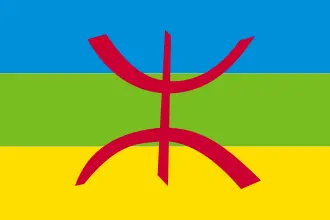
Berberism (Amazigh activism) is the North African movement for recognition of Berber identity, history and languages, chiefly in Morocco and Algeria. Its core demands are official status and schooling for Tamazight, an end to Arabisation, a rewritten national history and development of marginalised Berber regions. In Algeria the Kabyle strand also pressed for pluralist democracy and secularism against single-party and Islamist politics, while the Moroccan strand has mostly worked within the monarchy.
What it stands for
- A president should be limited in how many times he or she may stand for re-election.
- Democracy is best even when voters make poor choices.
- Public institutions should help minority languages be used in public life, for example through teaching or services in those languages.
- A country can get through deadlock among its institutions without a leader who overrides them.
- The state should not make one language the only common language of government, schooling and public life at the cost of limiting others.
- Today's nation is the same people as its ancient and medieval forebears.
Key figures
- Mouloud Mammeri: Kabyle writer whose banned 1980 lecture triggered the Berber Spring and who founded the Berber academy in Paris.
- Mohamed Chafik: Moroccan Amazigh intellectual credited with writing the 2000 Berber Manifesto.
Closest ideologies
- Regionalism (94% match)
- Democracy (93% match)
- Jewish Autonomism (91% match)
- Artiguism (91% match)
- Post-Marxism (91% match)
People closest to it
- Satyendra Nath Bose (91% alike)
- Rudolf Steiner (90% alike)
- Nandan Nilekani (90% alike)
- Benazir Bhutto (89% alike)
- Émile Durkheim (89% alike)
Key positions
- Strongly: A president should be limited in how many times he or she may stand for re-election.
- Strongly: Democracy is best even when voters make poor choices.
- Strongly: Public institutions should help minority languages be used in public life, for example through teaching or services in those languages.
- Strongly: A country can get through deadlock among its institutions without a leader who overrides them.
- Strongly: The state should not make one language the only common language of government, schooling and public life at the cost of limiting others.
- Strongly: Today's nation is the same people as its ancient and medieval forebears.
- Strongly: Ethnic diversity does not weaken a society's ability to hold together.
- Strongly: A nation does not need one main ethnic group: it can be made up of people of many ancestries.
- Strongly: Publicly honouring a national leader as the personification of the nation is not acceptable.
- Strongly: Public institutions should have the power to constrain a national majority's decisions in a liberal democracy.
- Strongly: Art should not be censored for its effect on people's moral character.
- Strongly: The political left should give cultural identity issues at least as much attention as workers' material interests.
- Strongly: The government should let its political opponents organise, speak and compete for power.
- Strongly: Rapid economic development does not justify temporary restrictions on political freedom.
- Strongly: The law should treat everyone as an equal, whatever their birth, sex, race or status.
- Strongly: Belonging to the nation does not go with sharing its religion.
- Strongly: Most of the average difference in ability between racial groups does not come from genes.
- Strongly: Workers do not need a disciplined revolutionary party to lead them.
- Strongly: The state should not steer people of the majority group toward settling in regions where minorities predominate.
- Strongly: News media should decide for themselves what they publish, whoever holds power.
- Strongly: No party's ideology should give it an exclusive right to lead the state.
- Strongly: The armed forces may be controlled by someone other than the governing party's leadership.
- Strongly: There is no deliberate plan behind immigration aimed at replacing the native population.
- Strongly: People of different races should not be discouraged from forming a family together, including through marriage and children.
- Strongly: No state may force a minority out of the country, however hostile it judges that minority to be.
- Strongly: Some areas of life should remain outside state direction.
- Strongly: Private owners' choice of whom they deal with should be subject to some restrictions.
- Strongly: No society has the right to rule another for its supposed improvement, however advanced it is.
- Strongly: A market economy is incompatible with socialism under communist-party leadership.
- Strongly: A workers' state does not need to suppress the old ruling class, even for a time.
- Strongly: Society needs government of some kind.
- Strongly: The slaughter of cattle should be legal.
- Strongly: Government should have other tasks besides protecting people from physical violence.
- Strongly: Public policy should not be used to reduce the passing on of inherited disabilities.
- Strongly: Political authority need not rest on oaths of loyalty sworn to a lord.
- Strongly: Voting should not be limited to members of one ethnic group.
- Strongly: Taking part in politics is at least as good a way to live as living privately away from public affairs.
- Strongly: Public spaces such as schools and facilities should not be separated by race under the law.
- Strongly: Women may go out in public without any legal duty to cover fully.
- Strongly: Final authority over a state's laws need not belong to its most senior religious scholars.
- Strongly: People must be free to leave their religion without legal penalty.
- Strongly: Museums, libraries and other inherited culture should not be destroyed, even when they stand in the way of new creation.
- Strongly: Humanity would gain nothing by going back to living off hunting and gathering.
- Strongly: Farmers should have the legal freedom to leave the estates they work.
- Leans: A nation should revive its culture first and build its state afterward.
- Leans: A national minority should run its own schools, language and cultural institutions inside the state it lives in.
- Leans: Government should maintain a strict institutional separation from religion.
- Leans: Politics should give compromises among competing groups at least as much weight as a single common good identified by reasoning.
- Leans: Speaking a common language is sufficient for people to constitute one nation.
- Leans: Religious values and institutions should not have a major part in shaping laws, schools and public life.
- Leans: Seeking equal rights in their countries of residence should take priority over leaving to establish a homeland as the response to persecution.
- Leans: Areas where an ethnic minority makes up most of the population should be able to run many of their own affairs within the state.
- Leans: Government should serve people's good while respecting each person as more than an instrument of the state or community.
- Leans: Political decisions should rest with the smallest local community able to handle them, with wider authorities handling matters that need a wider reach.
- Leans: Within a country, the richer regions grew rich by draining the poorer ones, much as colonial powers drained their colonies.
- Leans: Indigenous peoples should control their traditional territories.
- Leans: The government should steer investment into industries it sees as key to the country's future.
- Leans: Students should pay no tuition to attend public higher education institutions.
- Leans: Countries within one civilization may remain politically separate.
- Leans: The holder of the highest state office need not be treated as holy.
- Leans: An ancestral bond to a land gives a people a claim that outweighs the claims of other peoples who now live there.
- Leans: An electorate should choose the head of state, either directly or through elected representatives.
- Leans: Government should rely at least as much on legal enforcement as on its rulers' moral example.
- Leans: In law, a country's traditional national church should rank no higher than other religious bodies.
- Leans: Politics is not best understood as a contest between spiritual good and evil.
- Leans: Police forces should continue to exist.
- Leans: Political representation should not come through social bodies such as families, local communities and occupational associations instead of political parties.
- Leans: It is legitimate to take pride in the racial group one belongs to.
- Leans: The existing governing institutions should be retained, even if their personnel, policies or procedures change.
- Leans: Racial groups should not each organise to defend distinct political interests of their own.
- Leans: Keeping a nation's inherited culture alive, including its language, customs and traditions, matters.
- Leans: Political power may rest on something other than workplace-elected councils.
- Leans: A people with a shared national identity is entitled to its own self-governing state.
- Leans: Laws should not be required to follow religious texts.
- Leans: Religion does not offer illusory comfort for material suffering.
- Leans: An armed minority's actions are incapable of bringing about the conditions for a broader revolutionary uprising.
- Leans: Groups have rights of their own.
- Leans: School history should mostly tell the story of the student's own nation.