Political Ideology Atlas · All ideologies · Take the test
Anti-revisionism
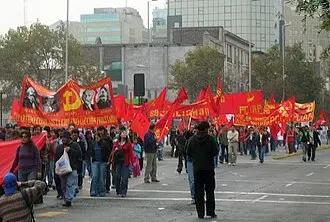
Anti-revisionism is the Marxist-Leninist current that arose in the mid-1950s against Khrushchev's reforms and kept Stalin's legacy. It holds that revolution, a vanguard party and a continuing dictatorship of the proletariat are indispensable, that class struggle persists under socialism, and that the post-Stalin Soviet leadership restored capitalism, calling it state-capitalist and social-imperialist.
What it stands for
- Education provided by the state should encourage people to reject belief in God.
- A workers' state must suppress the old ruling class for a time.
- When rival great powers go to war, workers should work to make their own state lose.
- One ideologically correct party should hold state leadership without competing parties having a right to replace it.
- Religion gives people a false consolation for hardship in their material lives.
- Workers require political leadership from a tightly organised revolutionary party.
Key figures
- Mao Zedong: CCP leader whose party launched the open polemics against Khrushchev's revisionism
- Enver Hoxha: Leader of the Party of Labour of Albania, the other major pole of anti-revisionism
Closest ideologies
- Marxism–Leninism–Maoism (92% match)
- Hoxhaism (90% match)
- Maoism (90% match)
- Bolshevism (89% match)
- Communism (89% match)
People closest to it
- Maxim Gorky (90% alike)
- Mao Zedong (88% alike)
- Kwame Nkrumah (87% alike)
- Ho Chi Minh (85% alike)
- Vladimir Lenin (84% alike)
Key positions
- Strongly: Education provided by the state should encourage people to reject belief in God.
- Strongly: A workers' state must suppress the old ruling class for a time.
- Strongly: When rival great powers go to war, workers should work to make their own state lose.
- Strongly: One ideologically correct party should hold state leadership without competing parties having a right to replace it.
- Strongly: Religion gives people a false consolation for hardship in their material lives.
- Strongly: Workers require political leadership from a tightly organised revolutionary party.
- Strongly: Farming should be organized as joint cultivation by groups of farmers instead of separate individual farm operations.
- Strongly: A socialist state with hostile countries all around it should work to make its state power stronger.
- Strongly: Conflicts between social classes persist after a society becomes socialist.
- Strongly: An economy whose production is directed by a central plan is capable of working better than an economy directed by market exchange.
- Strongly: History is mainly driven by conflict between economic classes.
- Strongly: Political change should replace the existing administrative and coercive institutions with new forms of organization, rather than put new leaders in charge of the old apparatus.
- Strongly: Historical change comes mainly from changes in how society produces and exchanges goods.
- Strongly: Laws, police and government mainly serve the interests of whoever owns the economy and holds power.
- Strongly: Wars between great powers are an unavoidable consequence of capitalism.
- Strongly: Owners' profit is value taken from workers' labor.
- Strongly: The government should have authority over religious institutions' internal affairs.
- Strongly: People should work mainly out of responsibility to society and a shared purpose, with personal material rewards playing a secondary role.
- Strongly: Cooperation between employers and workers should not come before conflict where their interests differ.
- Strongly: Workers should form a party of their own, separate from the parties already in place.
- Strongly: The farmers who work large estates should take ownership from the landowners, with the transfer compulsory if owners refuse.
- Strongly: Using military force in other countries is never necessary to protect people's human rights, even to stop a massacre.
- Strongly: Government should maintain a strict institutional separation from religion.
- Strongly: Society does not need a third course beyond capitalism and communism.
- Strongly: Religious values and institutions should not have a major part in shaping laws, schools and public life.
- Strongly: State schools should not teach religion.
- Strongly: Political power may be concentrated in one body.
- Strongly: Property need not be spread among many small owners.
- Strongly: Having wealth does not by itself create a duty to help those who are worse off.
- Strongly: A general collapse of capitalism is unavoidable.
- Strongly: What things are worth comes from the work put into them.
- Strongly: Production should be organised to provide what people need, instead of being organised around what yields a profit.
- Strongly: The global economic system keeps poorer countries poor by directing their wealth toward richer countries.
- Strongly: Communist one-party states should not receive the same condemnation as fascist states.
- Strongly: Industries such as energy, rail and utilities should be owned by the state or public bodies, not private companies.
- Strongly: Defeating communism should not take priority over coexistence with it.
- Strongly: Whether a policy fits an ideology should count independently of its results.
- Strongly: The economy should not combine mainly private markets with government support for people who cannot meet their basic needs.
- Strongly: Without workers' own political power, state ownership is not socialism.
- Strongly: Formal press freedom is hollow when wealth decides who can actually be heard.
- Strongly: The government should steer investment into industries it sees as key to the country's future.
- Strongly: After members debate and adopt a party decision, every member should have to help implement it, including those who opposed it.
- Strongly: A poor country should develop mainly with its own resources.
- Strongly: The left-right division in politics remains meaningful.
- Strongly: Political freedom can last without economic freedom.
- Strongly: Society may be changed in large, rapid steps.
- Strongly: Publicly funded services such as hospitals and schools should not be run by private companies and charities.
- Strongly: Workers' solidarity with workers in other countries should count at least as much as solidarity with their own nation.
- Strongly: Free trade does not benefit everyone in the long run.
- Strongly: A nation need not wait for a cultural revival before building its state.
- Strongly: Firms in a market economy need not be owned by the people who work in them.
- Strongly: Owners' rights to their property need not be protected against being overridden for public goals.
- Strongly: The law should impose no restrictions on strikes.
- Strongly: A country should not be ready to use military force abroad without UN Security Council authorization.
- Strongly: Officials decide what gets made and who gets it at least as well as prices and competition do.
- Strongly: Ethnic diversity does not weaken a society's ability to hold together.
- Strongly: The best constitution does not combine rule by the few with rule by the many.
- Strongly: In law, a country's traditional national church should rank no higher than other religious bodies.
- Strongly: It is not true that communities should be free to choose their own economic arrangements with no fixed blueprint for a free society's economy.
- Strongly: A former empire should claim no special ties, leadership or sphere of influence in its old territories.
- Strongly: Politics is not best understood as a contest between spiritual good and evil.
- Strongly: A country may keep all its decisions in its own hands rather than pooling them with other nations.
- Strongly: Political representation should not come through social bodies such as families, local communities and occupational associations instead of political parties.
- Strongly: Private charity does not help people in poverty better than government programs do.
- Strongly: Political independence means little unless the economic and property system is also transformed.
- Strongly: Nobody should hold a special rank by birth, such as a noble title, a hereditary crown or a caste position, or the special rights attached to one.
- Strongly: Spreading democracy does not bring peace.
- Strongly: A nation does not need one main ethnic group: it can be made up of people of many ancestries.
- Strongly: Wages need not be set through negotiating bodies that the state officially recognizes.
- Strongly: Public schooling money may go straight to schools instead of to parents as vouchers.
- Strongly: No one is better suited by nature to govern than anyone else.
- Strongly: Lasting socialism in one country does not require socialist revolutions abroad.
- Strongly: The presence of people of its nationality does not give a state a rightful claim to land beyond its borders.
- Strongly: Restoring a lost social order does not matter more than pursuing progress.
- Strongly: Other things drive humanity forward at least as much as rivalry and conflict between peoples.
- Strongly: Even a purely ceremonial head of state should not hold the position by birth.
- Strongly: Land does not belong to whoever first puts it to use.
- Strongly: Foreign armies should not be based on the country's territory.
- Strongly: The holy scripture of one's faith is not God's own error-free word.
- Strongly: Whatever their circumstances, everyone should be able to count on the state for enough to live decently, through benefits, pensions or public services.
- Strongly: Political violence is sometimes justified.
- Strongly: Income from useful work should be rewarded ahead of income from merely owning property.
- Strongly: A people with a shared national identity is entitled to its own self-governing state.
- Strongly: Being powerful does not mean a country should bring more land within its borders.
- Strongly: Political authority does not ultimately come from God.
- Strongly: The leader should not bypass political intermediaries in dealing with the people.
- Strongly: A country may leave other nations to choose their own political systems.
- Strongly: Elected governments need not leave monetary policy to central banks acting on their own.
- Strongly: State pensions funded by current workers' contributions should stay in place rather than be replaced by privately managed individual accounts.
- Strongly: In an economy with common ownership of productive assets, people should still own their personal belongings.
- Strongly: A government needs more than fair elections to be democratic.
- Strongly: Being the first to use force can be right, depending on what it is meant to achieve.
- Strongly: Belonging to the nation does not go with sharing its religion.
- Strongly: Most of the average difference in ability between racial groups does not come from genes.
- Strongly: Laws should not be required to follow religious texts.
- Strongly: Looking after your own interests is not a moral good in itself.
- Strongly: At least some revolutions have been justified.
- Strongly: Small, informal, trust-based groups should not take the place of lasting parties, unions and federations in political action.
- Strongly: Public school science classes may teach evolution on its own.
- Strongly: Industrial society has done at least as much good as harm to humanity.
- Strongly: Population growth does not mainly drive lasting poverty.
- Strongly: There is no deliberate plan behind immigration aimed at replacing the native population.
- Strongly: No state may force a minority out of the country, however hostile it judges that minority to be.
- Strongly: Private owners' choice of whom they deal with should be subject to some restrictions.
- Strongly: No society has the right to rule another for its supposed improvement, however advanced it is.
- Strongly: Each country should hold ultimate authority over its natural resources, without foreign interests controlling them.
- Strongly: Women should be able to vote and stand for office on the same terms as men.
- Strongly: The vote keeps a government in check at least as well as being able to leave the country does.
- Strongly: A market economy is incompatible with socialism under communist-party leadership.
- Strongly: Some decisions should bind people who have not consented to them.
- Strongly: Police forces should continue to exist.
- Strongly: Society needs government of some kind.
- Strongly: Countries should keep their armed forces.
- Strongly: The slaughter of cattle should be legal.
- Strongly: The ruler should be subject to the country's laws.
- Strongly: The state should not be managed the way a well-run business is.
- Strongly: Government should have other tasks besides protecting people from physical violence.
- Strongly: Collecting taxes does not in itself amount to stealing people's money.
- Strongly: Belonging to a religious minority is no ground for shoppers to stay away from a shop.
- Strongly: Great powers should have no right to send troops against allied governments' wishes for the purpose of preserving those countries' political systems.
- Strongly: Political authority need not rest on oaths of loyalty sworn to a lord.
- Strongly: Voting should not be limited to members of one ethnic group.
- Strongly: Killing another person can be right in self-defence or in defence of others.
- Strongly: Overseas territories need not be run mainly for the ruling country's economic benefit.
- Strongly: The holder of the highest state office need not be treated as holy.
- Strongly: Taking part in politics is at least as good a way to live as living privately away from public affairs.
- Strongly: A weaker state need not formally treat a stronger power as its superior.
- Strongly: People without property should also have the right to vote.
- Strongly: Public spaces such as schools and facilities should not be separated by race under the law.
- Strongly: Courts need not be handed over to private businesses.
- Strongly: Final authority over a state's laws need not belong to its most senior religious scholars.
- Strongly: Humanity would gain nothing by going back to living off hunting and gathering.
- Strongly: Farmers should have the legal freedom to leave the estates they work.
- Leans: Work should no longer be divided into separate specialized jobs held by different people.
- Leans: Political power should rest on councils elected in workplaces in place of parliaments.
- Leans: Poor countries should stop economic relations with wealthy countries.
- Leans: The government should stop its political opponents from organising, speaking or competing for power.
- Leans: Politics need not concern itself with people's spiritual needs.
- Leans: Consent of the governed is not the only basis of legitimate political authority.
- Leans: Society should aim for people to end up with broadly equal material conditions.
- Leans: It is acceptable to praise a national leader openly as the one who stands for the whole nation.
- Leans: Where they conflict, evidence and reasoning should count for more than faith, God, revelation or scripture.
- Leans: In the society we should aim for, a person's needs should determine their share of goods.
- Leans: People seeking political change should act directly—for example, with strikes, boycotts or occupations—instead of pursuing change through elections and parliaments.
- Leans: A free, fair society can be reached through methods that fall short of being free and fair.
- Leans: People with advanced schooling are cut off from how ordinary people live and work.
- Leans: Democracy is not the best form of government when voters choose badly.
- Leans: Those who inherit a large fortune should hand over a big share of it in tax.
- Leans: Belonging to the nation does not tie a person's life to a sacred community that goes on after their death.
- Leans: The Soviet economy was capitalist under state ownership, with the state taking the place of private capitalists.
- Leans: The nation does not need a radical rebirth to overcome decadence.
- Leans: Politics should give compromises among competing groups at least as much weight as a single common good identified by reasoning.
- Leans: The ruling class does not stay in power mainly through people going along with its ideas.
- Leans: Entertainment produced for mass audiences tends to weaken people's willingness to challenge the established social order.
- Leans: Armaments need not be limited to the minimum needed for national safety.
- Leans: Businesses need not belong to the people who work in them.
- Leans: Government should not be bound by a written bill of rights protected against easy amendment by ordinary majorities.
- Leans: Wealthy countries have no duty to give substantial aid to the world's poor abroad.
- Leans: Workers should not have democratic voting rights in the management of large companies.
- Leans: Agreements between competing firms, price-fixing included, need not be outlawed.
- Leans: Elected officials have at least as much real power as the people who run the press, universities and other cultural institutions.
- Leans: People should want as few material things as possible.
- Leans: Technology will not solve most of humanity's problems.
- Leans: Countries that feel dominated by Western powers should band together to resist them.
- Leans: Cultural life inside a state should not be placed under the control of each national minority.
- Leans: Armed forces may sometimes be used for purposes beyond defending the country against attack.
- Leans: The foreign debts of poor countries should be written off, ending their obligation to repay them.
- Leans: My country should stay neutral and join neither of the opposing great-power alliances.
- Leans: Every treaty and agreement between governments should be made public.
- Leans: Trade deals may leave out legally binding requirements protecting workers.
- Leans: Non-citizens should also be eligible for welfare benefits.
- Leans: Countries within one civilization may remain politically separate.
- Leans: Another body may have the final say over what the legislature passes.
- Leans: Land that a state declares its own against its people's will is still illegally occupied by that state.
- Leans: How someone turns out is shaped more by upbringing, society and experience than by the traits they are born with.
- Leans: Each country's communist party should decide its strategy for socialism without taking orders from another country's party.
- Leans: Basic local services, such as water, hospitals and local transport, should be publicly owned and run.
- Leans: Government should rely at least as much on legal enforcement as on its rulers' moral example.
- Leans: Workers are better off for having labor unions.
- Leans: Peoples who share an ethnic heritage, such as the Slavic peoples, should not come together in one state.
- Leans: Being free requires having the practical resources to act on one's choices, such as an adequate livelihood.
- Leans: The nation's cause and the cause of its ordinary working people are one and the same.
- Leans: People may live and work outside communities that own their property together.
- Leans: National policy should give priority to preventing outside powers from splitting the country territorially.
- Leans: Constantly seeking additional possessions is harmful overall, despite any benefits it brings.
- Leans: The state may restrict what adults do for reasons other than preventing harm to others.
- Leans: Trade, finance and debt rules should be changed to give poorer countries a fairer share.
- Leans: Most people in political office look after themselves first and the public second.
- Leans: Private ownership is legitimate only insofar as it benefits society.
- Leans: Racial groups should not each organise to defend distinct political interests of their own.
- Leans: My country should not send weapons to foreign insurgents, whatever it thinks of the governments they fight.
- Leans: Leading roles in a country's economy should not depend on belonging to the majority national group.
- Leans: At most half of workers in wealthy countries benefit from the exploitation of poorer countries.
- Leans: War does not strengthen a nation's character.
- Leans: Local community ownership of the means of production should not replace private or state ownership.
- Leans: Lending money at interest should be legal.
- Leans: A mother country and its colonies may trade with the outside world.
- Leans: Businesses gain too much influence over government policy from their lobbying.
- Leans: Groups have rights of their own.
- Leans: The law should treat everyone as an equal, whatever their birth, sex, race or status.