Political Ideology Atlas · All ideologies · Take the test
Americanism (ideology)
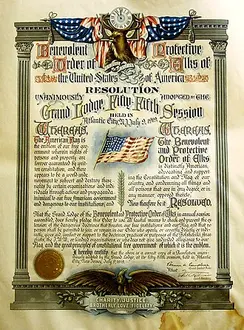
Americanism is loyalty to the United States and to the political creed its defining sources see as its founding principles. In its best-known form, the 'one hundred percent Americanism' of Theodore Roosevelt and the Americanization movement, it demands undivided national allegiance, the English language and the assimilation of immigrants, judges citizens by conduct rather than ancestry or creed, and keeps church and state apart. A second strand, set out by C. Bradley Thompson with Ayn Rand's and Leonard Read's texts, reads it as the individual-rights philosophy of the Declaration of Independence: limited government, private property and free exchange. The word is famously contested, and its sources divide wherever these strands, or the later left and right uses Thompson reports, disagree.
What it stands for
- A right belongs to an individual, even where several people exercise it together.
- Public institutions do not need to help minority languages be used in public life.
- The state should make one language the only common language of government, schooling and public life, limiting the use of others.
- Owners' rights to their property should almost never be overridden, even for public goals.
- The state should stay neutral between its citizens' ways of life.
- Industries such as energy, rail and utilities do not need to be publicly owned.
Closest ideologies
- Make America Great Again (90% match)
- Thatcherism (88% match)
- Manifest destiny (88% match)
- American nationalism (88% match)
- Fortuynism (87% match)
People closest to it
- Vivek Ramaswamy (90% alike)
- Clarence Thomas (89% alike)
- Nigel Farage (89% alike)
- Ron Johnson (89% alike)
- Rudy Giuliani (89% alike)
Key positions
- Strongly: A right belongs to an individual, even where several people exercise it together.
- Strongly: Public institutions do not need to help minority languages be used in public life.
- Strongly: The state should make one language the only common language of government, schooling and public life, limiting the use of others.
- Strongly: Owners' rights to their property should almost never be overridden, even for public goals.
- Strongly: The state should stay neutral between its citizens' ways of life.
- Strongly: Industries such as energy, rail and utilities do not need to be publicly owned.
- Strongly: Society does not need a third course beyond capitalism and communism.
- Strongly: Government should be bound by written guarantees of basic rights protected against easy amendment by ordinary majorities.
- Strongly: Communist one-party regimes should be condemned as severely as fascist regimes.
- Strongly: The government should be able to require citizens to serve in the military.
- Strongly: Government should serve people's good while respecting each person as more than an instrument of the state or community.
- Strongly: In the society we should aim for, a person's share of goods may depend on things besides their needs.
- Strongly: Employers and workers should treat each other as partners whose cooperation comes before conflict, even where their interests differ.
- Strongly: People may live and work outside communities that own their property together.
- Strongly: An electorate should choose the head of state, either directly or through elected representatives.
- Strongly: Firms in a market economy need not be owned by the people who work in them.
- Strongly: A nation can be made up of several ethnic groups with none forming most of its people.
- Strongly: A person's body belongs entirely to that person.
- Strongly: In law, a country's traditional national church should rank no higher than other religious bodies.
- Strongly: The state should make immigrants learn the language of the country they settle in.
- Strongly: Parties and offices should cut across religious lines.
- Strongly: Some things are right or wrong for everyone, in every culture and era.
- Strongly: Schools should cultivate patriotic feeling: loyalty to and pride in the nation, expressed for example through respect for its flag and anthem.
- Strongly: Individual farms should not give way to joint cultivation by groups of farmers.
- Strongly: The law should treat everyone as an equal, whatever their birth, sex, race or status.
- Strongly: State ownership should stop short of covering all land.
- Strongly: An economy directed by a central plan is not capable of working better than one directed by market exchange.
- Strongly: Countries may keep controls on who enters and settles, even in the long run.
- Strongly: Soldiers and conscripts need not refuse to fight when their state goes to war.
- Strongly: Public institutions should have the power to constrain a national majority's decisions in a liberal democracy.
- Strongly: No party's ideology should give it an exclusive right to lead the state.
- Strongly: Members of other ethnic groups should be free to stay in the country.
- Strongly: Naturalized citizens may hold public office as well as people born in the country.
- Strongly: In the long run people should still produce and share using money.
- Strongly: Work may stay divided into separate specialized jobs held by different people.
- Strongly: A workers' state does not need to suppress the old ruling class, even for a time.
- Strongly: In a war between great powers, workers need not seek their own government's defeat.
- Strongly: Police forces should continue to exist.
- Strongly: Some areas of life should remain outside state direction.
- Strongly: Society needs government of some kind.
- Strongly: Publicly insulting a religion's sacred beliefs should be left outside the criminal law.
- Strongly: Countries should keep their armed forces.
- Strongly: Religious conversion should be free of legal restriction.
- Strongly: Voters of different religious communities may all vote in the same elections.
- Strongly: Killing another person can be right in self-defence or in defence of others.
- Strongly: Voting should not be limited to members of one ethnic group.
- Strongly: Public spaces such as schools and facilities should not be separated by race under the law.
- Strongly: Courts need not be handed over to private businesses.
- Strongly: People must be free to leave their religion without legal penalty.
- Leans: A state may force a minority it sees as hostile to leave the country.
- Leans: How ownership affects the wider community is not a required test of whether it is legitimate.
- Leans: Young people should belong to uniformed, drilled organisations that prepare them to serve the nation.
- Leans: A nation may trace its roots to antiquity without having existed as the same people throughout that time.
- Leans: A country should limit who may immigrate according to their race.
- Leans: Workers' solidarity with their own nation should take priority over solidarity with workers across borders.
- Leans: Prices and competition generally decide better than officials what gets made and who gets it.
- Leans: Areas where an ethnic minority is the majority may be governed in the same way as the rest of the state.
- Leans: Opening markets across borders leaves every trading country better off over time.
- Leans: Armaments need not be limited to the minimum needed for national safety.
- Leans: Tax rates should not rise steeply with income.
- Leans: My country's military strength should exceed that of its rivals.
- Leans: Whether a policy fits an ideology should count independently of its results.
- Leans: Workers may be represented through the parties already in place.
- Leans: Democracy is best even when voters make poor choices.
- Leans: When national priorities conflict with working together internationally, my country should choose its own priorities.
- Leans: The state should limit or screen money that foreign donors give to charities, campaign groups, the press and universities.
- Leans: Being a foreigner should not by itself bar someone from owning land in the country.
- Leans: To keep their political freedoms, people need the freedom to own property, trade and choose their work.
- Leans: Heirs to large fortunes may keep most of what they inherit.
- Leans: Marriage, inheritance and family law should be the same for everyone, not set by each religious community.
- Leans: The economy should not combine mainly private markets with government support for people who cannot meet their basic needs.
- Leans: Working for wages should remain a normal way for people to earn a living.
- Leans: Farmers should not be given state protection against swings in the prices they receive.
- Leans: Political action should leave other people's property unharmed.
- Leans: A business owner can earn a profit without taking unfair advantage of employees.
- Leans: Immigration should favour people who already share the country's culture.
- Leans: Defense should not rest with armed ordinary citizens in place of a standing force.
- Leans: The state should treat all streams and interpretations of a religion equally under the law.
- Leans: Tariffs should not be used to protect domestic industry from foreign competition.
- Leans: Collecting taxes does not in itself amount to stealing people's money.
- Leans: Rich people have an obligation to help those worse off than they are.
- Leans: Capitalism built the productive power and wealth that later and better societies rest on.
- Leans: The country should impose strict limits on immigration.
- Leans: Governments should not fix maximum prices for essential foods, even in times of scarcity.
- Leans: Governments should not borrow heavily, spending much more than they collect in taxes, to boost the economy.
- Leans: A country may keep a region that wants to leave.
- Leans: Price controls do more harm than good against inflation.
- Leans: Industrial society has done at least as much good as harm to humanity.
- Leans: People are entitled to resist a ruler's unconstitutional exercise of power.
- Leans: One worker's pay should cover the living needs of that worker's family, including the worker.
- Leans: Those who govern can have a legitimate claim to power without a divine mandate.
- Leans: A person loses freedom from being at another person's mercy, even if that power is never exercised.
- Leans: People need not organize along racial lines to stand up for the concerns of their group.
- Leans: The reassurance people draw from faith in the face of material hardship need not be founded on false hopes.
- Leans: Politics should support people's spiritual well-being.
- Leans: Rulers have a right to rule only because the people they rule have agreed to it.
- Leans: Rulers must act under lasting, publicly known laws administered by recognised courts.
- Leans: Equality of outcomes should not be society's goal.
- Leans: Public schooling money may go straight to schools instead of to parents as vouchers.
- Leans: Laws should not be required to follow religious texts.