Political Ideology Atlas · All people · Take the test
North America · born 1948
Clarence Thomas
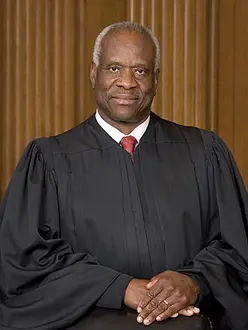
Associate Justice of the U.S. Supreme Court (1991-present); chairman of the Equal Employment Opportunity Commission (1982-1990)
A natural-rights originalist who reads the Constitution through the Declaration of Independence: government exists to secure God-given individual rights, power should be divided and limited, and the law should be colorblind. He opposes racial preferences, disparate-impact liability, broad federal power under the Commerce Clause and delegation of lawmaking, supports gun rights, school choice, religious exemptions and presidential control of the executive branch, and distrusts expert and administrative rule.
Closest ideologies
Based on the 39 statements where Clarence Thomas has a known position.
- Black conservatism in the United States (92% match)
- Anti-environmentalism (91% match)
- Fusionism (88% match)
- Libertarian Conservatism (88% match)
- Fiscal conservatism (88% match)
Similar people
- Ben Sasse (90% alike)
- Vivek Ramaswamy (89% alike)
- Alex Jones (89% alike)
- Ronald Reagan (88% alike)
- John Adams (87% alike)
Known positions
- Strongly: Individuals hold rights; groups have no rights of their own beyond the rights of their members.
- Strongly: Public education money should follow the child to whichever school the family picks.
- Strongly: Freedom does not require the material means to exercise it.
- Strongly: Owners' rights to their property should almost never be overridden, even for public goals.
- Strongly: Believers can be excused from rules, such as dress or work-day rules, that conflict with their faith.
- Strongly: Admissions, hiring and contracts should not favor anyone on the basis of race.
- Strongly: Government should be bound by written guarantees of basic rights protected against easy amendment by ordinary majorities.
- Strongly: Political power should be split among separate branches and levels that can each limit the others.
- Strongly: Government should serve people's good while respecting each person as more than an instrument of the state or community.
- Strongly: Ideas of what men and women are like do not come mostly from culture.
- Strongly: Some things are right or wrong for everyone, in every culture and era.
- Strongly: Owning a gun should not face strict legal limits.
- Strongly: Transgender people's legal gender should not be based on their gender identity.
- Strongly: The general public should have at least as much say in policy as experts.
- Strongly: Public institutions should have the power to constrain a national majority's decisions in a liberal democracy.
- Strongly: Equality of outcomes should not be society's goal.
- Strongly: Rulers have a right to rule only because the people they rule have agreed to it.
- Strongly: Racial groups should not each organise to defend distinct political interests of their own.
- Strongly: An economy directed by a central plan is not capable of working better than one directed by market exchange.
- Strongly: Unequal results between racial groups do not by themselves make a policy discriminatory.
- Strongly: Elected governments need not leave monetary policy to central banks acting on their own.
- Strongly: The law should treat everyone as an equal, whatever their birth, sex, race or status.
- Strongly: Classifying people by sex tracks differences that exist whatever society says.
- Strongly: Society needs government of some kind.
- Strongly: Voting should not be limited to members of one ethnic group.
- Strongly: Public spaces such as schools and facilities should not be separated by race under the law.
- Leans: Private property does not need to serve the common good to be justified.
- Leans: A national emergency sometimes justifies temporarily withdrawing normal legal safeguards against people the government regards as internal enemies, such as protections against detention without trial.
- Leans: Individual rights matter at least as much as what citizens owe their community.
- Leans: Real authority to command the military should rest with the head of state.
- Leans: Communist one-party regimes should be condemned as severely as fascist regimes.
- Leans: Some institutional ties between government and religion are acceptable.
- Leans: Children of citizens are not the only ones who should be citizens at birth.
- Leans: Political decisions should rest with the smallest local community able to handle them, with wider authorities handling matters that need a wider reach.
- Leans: Human rights come from the nature that all human beings share.
- Leans: A healthy society depends on the traditional family, such as a married mother and father raising their children.
- Leans: The law should not punish consenting adults for same-sex relations.
- Leans: At least some revolutions have been justified.