Political Ideology Atlas · All people · Take the test
North America · born 1822, historical
Rutherford B. Hayes
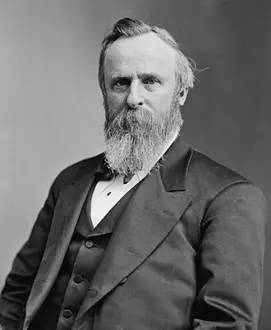
U.S. president (1877–1881); Ohio governor and post-presidential reform advocate
Hayes backed Reconstruction and equal civil rights in Congress, then ended federal military support for the remaining Republican state governments in the South and vetoed bills weakening federal election enforcement. As president he promoted merit-based civil service and restored gold convertibility. In retirement he worked on prison reform and criticized the concentration of wealth.
Closest ideologies
Based on the 44 statements where Rutherford B. Hayes has a known position.
- Zionism (88% match)
- Illiberal democracy (88% match)
- Pinochetism (88% match)
- Christian democracy (87% match)
- Ottomanism (87% match)
Similar people
- Felipe VI of Spain (91% alike)
- Péter Magyar (89% alike)
- Francis Fukuyama (89% alike)
- William Howard Taft (89% alike)
- George Washington (89% alike)
Known positions
- Strongly: At least some unjust laws impose a moral duty of obedience.
- Strongly: Reforms should take existing institutions and their role in society seriously.
- Strongly: Civil servants should be recruited according to their performance in competitive examinations.
- Strongly: Real authority to command the military should rest with the head of state.
- Strongly: Changes to society should be introduced a little at a time.
- Strongly: Elected politicians should serve only a small number of terms.
- Strongly: Government should maintain a strict institutional separation from religion.
- Strongly: Democracy is best even when voters make poor choices.
- Strongly: The state should be barred from executing people convicted of the gravest crimes, such as terrorism.
- Strongly: Those who inherit a large fortune should hand over a big share of it in tax.
- Strongly: Prisons should mainly help offenders rejoin society.
- Strongly: Political power should be split among separate branches and levels that can each limit the others.
- Strongly: Property should belong to many people in small holdings.
- Strongly: A president should be limited in how many times he or she may stand for re-election.
- Strongly: Even after fair acquisition, the shares people end up with bear on whether a distribution of wealth is fair.
- Strongly: Government should impose strict rules on how corporations operate.
- Strongly: Being the law gives a rule a moral claim to be obeyed.
- Strongly: Countries should accept binding international arbitration of their disputes.
- Strongly: Another body may have the final say over what the legislature passes.
- Strongly: Parties and offices should cut across religious lines.
- Strongly: Society relies for its well-being on longstanding family arrangements, such as a married mother and father raising their children.
- Strongly: Rulers have a right to rule only because the people they rule have agreed to it.
- Strongly: The law should treat everyone as an equal, whatever their birth, sex, race or status.
- Strongly: Public institutions should have the power to constrain a national majority's decisions in a liberal democracy.
- Strongly: Very large concentrations of wealth threaten a free society.
- Strongly: Governments should give no subsidies, licences or protections that favour firms close to them.
- Strongly: When companies press officials for policies they want, they gain more sway over public decisions than they should have.
- Strongly: Society needs government of some kind.
- Strongly: Countries should keep their armed forces.
- Strongly: Collecting taxes does not in itself amount to stealing people's money.
- Strongly: Voting should not be limited to members of one ethnic group.
- Strongly: Government should have other tasks besides protecting people from physical violence.
- Leans: Labor unions do not necessarily make workers better off.
- Leans: Decisions about indigenous peoples' traditional lands may rest with the wider state, not with those peoples.
- Leans: A country should limit who may immigrate according to their race.
- Leans: Money creation should not be reserved exclusively to public institutions.
- Leans: When national priorities conflict with working together internationally, my country should choose its own priorities.
- Leans: Religious minorities should not be exempt from general laws that burden their practice.
- Leans: The country should impose strict limits on immigration.
- Leans: Religious values and institutions should shape laws, schools and public life.
- Leans: Political decisions should rest with the smallest local community able to handle them, with wider authorities handling matters that need a wider reach.
- Leans: Most of government should be funded by taxes other than a tax on the value of land.
- Leans: Public schooling money may go straight to schools instead of to parents as vouchers.