Political Ideology Atlas · All people · Take the test
North America · born 1942, historical
Huey P. Newton
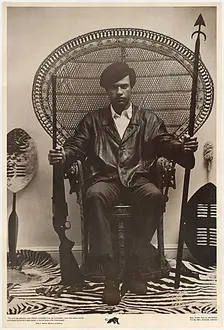
Co-founder and Minister of Defense of the Black Panther Party (1966-1989)
Co-founded the Black Panther Party for Self-Defense and developed its ideology from Black nationalism through revolutionary nationalism to revolutionary intercommunalism, a Marxist-influenced view of a world-wide struggle against a US-led empire. He favored community control of the means of production, a guaranteed livelihood, armed self-defense against police, a disciplined vanguard party and survival programs, and by 1970 urged alliance with the women's and gay liberation movements.
Closest ideologies
Based on the 116 statements where Huey P. Newton has a known position.
- Bundism (90% match)
- Trotskyism (89% match)
- Orthodox Trotskyism (89% match)
- Neo-Marxism (88% match)
- Marxist feminism (88% match)
Similar people
- Helen Keller (94% alike)
- Hasan Piker (89% alike)
- Bill Ayers (87% alike)
- W. E. B. Du Bois (86% alike)
- Eugene V. Debs (86% alike)
Known positions
- Strongly: In the long run people should be free to live and work in any country.
- Strongly: Farms, factories and utilities belong to the town or city that uses them.
- Strongly: Workers require political leadership from a tightly organised revolutionary party.
- Strongly: The fact that something is law is not, by itself, a moral reason to obey it.
- Strongly: Historical change comes mainly from changes in how society produces and exchanges goods.
- Strongly: Schools should not cultivate patriotic feeling, meaning loyalty to and pride in the nation.
- Strongly: Laws, police and government mainly serve the interests of whoever owns the economy and holds power.
- Strongly: Wars between great powers are an unavoidable consequence of capitalism.
- Strongly: Owners' profit is value taken from workers' labor.
- Strongly: Cooperation between employers and workers should not come before conflict where their interests differ.
- Strongly: Military service should always be voluntary.
- Strongly: Working together internationally should count at least as much as my country's own priorities.
- Strongly: Society does not need a third course beyond capitalism and communism.
- Strongly: The state should offer public work to anyone who wants a job and cannot find one.
- Strongly: Some race-based affirmative action should continue.
- Strongly: The global economic system keeps poorer countries poor by directing their wealth toward richer countries.
- Strongly: People outside state forces should also be allowed to bear arms.
- Strongly: Industries such as energy, rail and utilities should be owned by the state or public bodies, not private companies.
- Strongly: My country may keep a military no stronger than its rivals'.
- Strongly: Countries that feel dominated by Western powers should band together to resist them.
- Strongly: Defeating communism should not take priority over coexistence with it.
- Strongly: The economy should not combine mainly private markets with government support for people who cannot meet their basic needs.
- Strongly: Without workers' own political power, state ownership is not socialism.
- Strongly: Society should take active steps to make up for the harm done by past racial injustices.
- Strongly: After members debate and adopt a party decision, every member should have to help implement it, including those who opposed it.
- Strongly: Society may be changed in large, rapid steps.
- Strongly: Workers' solidarity with workers in other countries should count at least as much as solidarity with their own nation.
- Strongly: People are entitled to resist a ruler's unconstitutional exercise of power.
- Strongly: How someone turns out is shaped more by upbringing, society and experience than by the traits they are born with.
- Strongly: Owners' rights to their property need not be protected against being overridden for public goals.
- Strongly: Owning a gun should not face strict legal limits.
- Strongly: Officials decide what gets made and who gets it at least as well as prices and competition do.
- Strongly: Politics is not best understood as a contest between spiritual good and evil.
- Strongly: Private charity does not help people in poverty better than government programs do.
- Strongly: Political independence means little unless the economic and property system is also transformed.
- Strongly: A nation does not need one main ethnic group: it can be made up of people of many ancestries.
- Strongly: Meeting poor people's needs should be the first consideration in public policy.
- Strongly: Restoring a lost social order does not matter more than pursuing progress.
- Strongly: Rulers have a right to rule only because the people they rule have agreed to it.
- Strongly: Trade, finance and debt rules should be changed to give poorer countries a fairer share.
- Strongly: Racism is still the main obstacle to the advancement of disadvantaged racial groups.
- Strongly: Most people in political office look after themselves first and the public second.
- Strongly: Private ownership is legitimate only insofar as it benefits society.
- Strongly: Very large concentrations of wealth threaten a free society.
- Strongly: Whatever their circumstances, everyone should be able to count on the state for enough to live decently, through benefits, pensions or public services.
- Strongly: Political violence is sometimes justified.
- Strongly: A people with a shared national identity is entitled to its own self-governing state.
- Strongly: Being powerful does not mean a country should bring more land within its borders.
- Strongly: Protecting the constitution should be left to civilian institutions, not the armed forces.
- Strongly: The leader should not bypass political intermediaries in dealing with the people.
- Strongly: A country may leave other nations to choose their own political systems.
- Strongly: Businesses gain too much influence over government policy from their lobbying.
- Strongly: The law should treat everyone as an equal, whatever their birth, sex, race or status.
- Strongly: A government needs more than fair elections to be democratic.
- Strongly: Being the first to use force can be right, depending on what it is meant to achieve.
- Strongly: Most of the average difference in ability between racial groups does not come from genes.
- Strongly: At least some revolutions have been justified.
- Strongly: The law should not punish consenting adults for same-sex relations.
- Strongly: Small, informal, trust-based groups should not take the place of lasting parties, unions and federations in political action.
- Strongly: Population growth does not mainly drive lasting poverty.
- Strongly: No society has the right to rule another for its supposed improvement, however advanced it is.
- Strongly: Police forces should continue to exist.
- Strongly: Society needs government of some kind.
- Strongly: Government should have other tasks besides protecting people from physical violence.
- Strongly: Killing another person can be right in self-defence or in defence of others.
- Strongly: Overseas territories need not be run mainly for the ruling country's economic benefit.
- Strongly: Taking part in politics is at least as good a way to live as living privately away from public affairs.
- Strongly: A weaker state need not formally treat a stronger power as its superior.
- Strongly: Public spaces such as schools and facilities should not be separated by race under the law.
- Strongly: The Holocaust happened as historians describe it.
- Strongly: Suspected drug dealers should never be put to death without a trial.
- Leans: A state whose economy is publicly owned and planned should be defended against a return to capitalism even if a bureaucracy rules it.
- Leans: One ideologically correct party should hold state leadership without competing parties having a right to replace it.
- Leans: Individual soldiers and conscripts have a duty to refuse to fight in state wars.
- Leans: A socialist state with hostile countries all around it should work to make its state power stronger.
- Leans: An economy whose production is directed by a central plan is capable of working better than an economy directed by market exchange.
- Leans: Politics need not concern itself with people's spiritual needs.
- Leans: Members of every racial group should organise politically around interests specific to their group.
- Leans: History is mainly driven by conflict between economic classes.
- Leans: Political change should replace the existing administrative and coercive institutions with new forms of organization, rather than put new leaders in charge of the old apparatus.
- Leans: Society should aim for people to end up with broadly equal material conditions.
- Leans: Socialism in a single country will not endure without successful socialist revolutions in other countries.
- Leans: People should live and work in communities that own land and goods together and govern themselves.
- Leans: Every adult should get a regular payment from the state, whether or not they work.
- Leans: Where they conflict, evidence and reasoning should count for more than faith, God, revelation or scripture.
- Leans: In the society we should aim for, a person's needs should determine their share of goods.
- Leans: People seeking political change should act directly—for example, with strikes, boycotts or occupations—instead of pursuing change through elections and parliaments.
- Leans: Defense should rest with armed ordinary citizens, not a standing force.
- Leans: An assembly elected by the people for that purpose should draft the constitution.
- Leans: Tackling oppression requires a combined approach to its overlapping forms, such as racism, sexism and class oppression.
- Leans: Democracy is not the best form of government when voters choose badly.
- Leans: The farmers who work large estates should take ownership from the landowners, with the transfer compulsory if owners refuse.
- Leans: Science and technology will fix most of what goes wrong for people.
- Leans: Seeking equal rights in their countries of residence should take priority over leaving to establish a homeland as the response to persecution.
- Leans: Employees should have voting rights in the management of large companies.
- Leans: Wage work cuts people off from the meaning and creativity of what they make.
- Leans: Distance and nationality do not weaken the duty of the rich to help the poor abroad.
- Leans: Businesses should belong to the people who work in them, for example as cooperatives.
- Leans: The ruling class stays in power mainly through people going along with its ideas.
- Leans: Production should be organised to provide what people need, instead of being organised around what yields a profit.
- Leans: A person's body belongs entirely to that person.
- Leans: The Soviet economy was not capitalism under state ownership with the state in place of private capitalists.
- Leans: Political decisions should rest with the smallest local community able to handle them, with wider authorities handling matters that need a wider reach.
- Leans: Capitalism built the productive power and wealth that later and better societies rest on.
- Leans: A law imposes no moral duty to obey it if the law is unjust.
- Leans: People should have a direct role in making decisions where they work, live and study, rather than having those decisions made entirely for them.
- Leans: Political institutions developed in the West are not a suitable model for every civilization.
- Leans: Being free requires having the practical resources to act on one's choices, such as an adequate livelihood.
- Leans: It is legitimate to take pride in the racial group one belongs to.
- Leans: Constantly seeking additional possessions is harmful overall, despite any benefits it brings.
- Leans: The political left should give cultural identity issues at least as much attention as workers' material interests.
- Leans: Income from useful work should be rewarded ahead of income from merely owning property.
- Leans: An armed minority's actions are incapable of bringing about the conditions for a broader revolutionary uprising.