Political Ideology Atlas · All people · Take the test
Europe · born 1883, historical
Clement Attlee
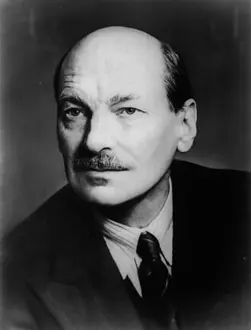
British Prime Minister (1945–1951) and Labour Party leader (1935–1955)
Attlee was a democratic socialist who sought a classless co-operative commonwealth through public ownership, planning and the welfare state, achieved by constitutional means and without dictatorship of Left or Right. As prime minister he led the nationalisations, the NHS, Indian independence and British entry into NATO, and he backed an independent British atomic bomb. In later life he opposed joining the Common Market, favoured a world rule of law and supported decriminalising homosexuality.
Closest ideologies
Based on the 144 statements where Clement Attlee has a known position.
- Ethical socialism (91% match)
- Market Socialism (90% match)
- Liberalism in the United States (89% match)
- Pashtun nationalism (89% match)
- Pragmatism (89% match)
Similar people
- Luiz Inácio Lula da Silva (92% alike)
- François Mitterrand (91% alike)
- Dilma Rousseff (90% alike)
- Jacques Chirac (90% alike)
- Ted Kennedy (90% alike)
Known positions
- Strongly: The UN should have authority to compel member states to comply with its decisions.
- Strongly: Society should aim for people to end up with broadly equal material conditions.
- Strongly: The representative legislature should have the final say on legislation.
- Strongly: A country's constitution should not automatically take precedence over international law.
- Strongly: Changes to society should be introduced a little at a time.
- Strongly: Workers should form a party of their own, separate from the parties already in place.
- Strongly: My country may join a military alliance led by one of the great powers.
- Strongly: Belonging to the nation does not tie a person's life to a sacred community that goes on after their death.
- Strongly: Working together internationally should count at least as much as my country's own priorities.
- Strongly: The state should offer public work to anyone who wants a job and cannot find one.
- Strongly: Besides its directly elected parliament, a legislature should have a second chamber, such as a senate.
- Strongly: Employees should have voting rights in the management of large companies.
- Strongly: Countries should maintain only the weapons needed for national safety.
- Strongly: Allies are bound to defend one another against armed attack.
- Strongly: High earners and the very rich should pay tax at a much higher rate than everyone else.
- Strongly: Production should be organised to provide what people need, instead of being organised around what yields a profit.
- Strongly: Industries such as energy, rail and utilities should be owned by the state or public bodies, not private companies.
- Strongly: Government should serve people's good while respecting each person as more than an instrument of the state or community.
- Strongly: Democracy is best even when voters make poor choices.
- Strongly: Major laws should not be decided by direct votes of citizens.
- Strongly: The government should steer investment into industries it sees as key to the country's future.
- Strongly: A country may join permanent military alliances.
- Strongly: After members debate and adopt a party decision, every member should have to help implement it, including those who opposed it.
- Strongly: The left-right division in politics remains meaningful.
- Strongly: Government should impose strict rules on how corporations operate.
- Strongly: A country can get through deadlock among its institutions without a leader who overrides them.
- Strongly: Each country's communist party should decide its strategy for socialism without taking orders from another country's party.
- Strongly: Direct action does not have to take the place of elections and parliament as the way to achieve political change.
- Strongly: Basic local services, such as water, hospitals and local transport, should be publicly owned and run.
- Strongly: A country should not be ready to use military force abroad without UN Security Council authorization.
- Strongly: Officials decide what gets made and who gets it at least as well as prices and competition do.
- Strongly: Workers are better off for having labor unions.
- Strongly: People should have a direct role in making decisions where they work, live and study, rather than having those decisions made entirely for them.
- Strongly: Being free requires having the practical resources to act on one's choices, such as an adequate livelihood.
- Strongly: A nation does not need one main ethnic group: it can be made up of people of many ancestries.
- Strongly: Young people should not be organised into uniformed, drilled groups that prepare them to serve the nation.
- Strongly: Wages need not be set through negotiating bodies that the state officially recognizes.
- Strongly: Publicly honouring a national leader as the personification of the nation is not acceptable.
- Strongly: Historical change does not come mainly from changes in how society produces and exchanges goods.
- Strongly: No one is better suited by nature to govern than anyone else.
- Strongly: The state should guarantee health care to everyone, whether it runs the services itself or pays for them.
- Strongly: Other things drive humanity forward at least as much as rivalry and conflict between peoples.
- Strongly: Rulers have a right to rule only because the people they rule have agreed to it.
- Strongly: The existing governing institutions should be retained, even if their personnel, policies or procedures change.
- Strongly: Very large concentrations of wealth threaten a free society.
- Strongly: Whatever their circumstances, everyone should be able to count on the state for enough to live decently, through benefits, pensions or public services.
- Strongly: War does not strengthen a nation's character.
- Strongly: Income from useful work should be rewarded ahead of income from merely owning property.
- Strongly: A people with a shared national identity is entitled to its own self-governing state.
- Strongly: Being powerful does not mean a country should bring more land within its borders.
- Strongly: The government should let its political opponents organise, speak and compete for power.
- Strongly: Protecting the constitution should be left to civilian institutions, not the armed forces.
- Strongly: The leader should not bypass political intermediaries in dealing with the people.
- Strongly: A mother country and its colonies may trade with the outside world.
- Strongly: Elected governments need not leave monetary policy to central banks acting on their own.
- Strongly: State pensions funded by current workers' contributions should stay in place rather than be replaced by privately managed individual accounts.
- Strongly: The law should treat everyone as an equal, whatever their birth, sex, race or status.
- Strongly: An armed minority's actions are incapable of bringing about the conditions for a broader revolutionary uprising.
- Strongly: Workers do not need a disciplined revolutionary party to lead them.
- Strongly: Laws should not be required to follow religious texts.
- Strongly: Looking after your own interests is not a moral good in itself.
- Strongly: Soldiers and conscripts need not refuse to fight when their state goes to war.
- Strongly: News media should decide for themselves what they publish, whoever holds power.
- Strongly: Political power may rest on something other than workplace-elected councils.
- Strongly: No party's ideology should give it an exclusive right to lead the state.
- Strongly: The law should not punish consenting adults for same-sex relations.
- Strongly: In a war between great powers, workers need not seek their own government's defeat.
- Strongly: The armed forces may be controlled by someone other than the governing party's leadership.
- Strongly: Central banks should keep a role in controlling the money supply.
- Strongly: Population growth does not mainly drive lasting poverty.
- Strongly: Some areas of life should remain outside state direction.
- Strongly: Women should be able to vote and stand for office on the same terms as men.
- Strongly: Some decisions should bind people who have not consented to them.
- Strongly: A workers' state does not need to suppress the old ruling class, even for a time.
- Strongly: Society needs government of some kind.
- Strongly: Voting should not be limited to members of one ethnic group.
- Strongly: Overseas territories need not be run mainly for the ruling country's economic benefit.
- Strongly: People without property should also have the right to vote.
- Strongly: Public spaces such as schools and facilities should not be separated by race under the law.
- Leans: Temporary rule by a more developed society is justified when it helps the ruled to progress.
- Leans: An economy whose production is directed by a central plan is capable of working better than an economy directed by market exchange.
- Leans: It is acceptable for a monarch who inherits the throne to be the country's symbolic head while others govern.
- Leans: People should lose their right to a plot of land when they no longer use it.
- Leans: Choices that harm no one else should never be crimes.
- Leans: My country should possess its own nuclear arsenal with independent authority over its use.
- Leans: People should be encouraged to live in ways that differ from social custom.
- Leans: Wars between great powers are an unavoidable consequence of capitalism.
- Leans: Owners' profit is value taken from workers' labor.
- Leans: Cooperation between employers and workers should not come before conflict where their interests differ.
- Leans: Workers' solidarity with their own nation should take priority over solidarity with workers across borders.
- Leans: The nation's figurehead should be non-partisan and belong to everyone.
- Leans: Trade deals should impose legally binding requirements protecting workers.
- Leans: Governments should set legal price ceilings on essential foods when supplies are scarce.
- Leans: A national minority should run its own schools, language and cultural institutions inside the state it lives in.
- Leans: Outside governments have no entitlement to interfere in another country's internal affairs for any purpose.
- Leans: Communist one-party regimes should be condemned as severely as fascist regimes.
- Leans: Distance and nationality do not weaken the duty of the rich to help the poor abroad.
- Leans: Trade unions should control their own affairs without state direction.
- Leans: Farmers should get price floors, state buying or cheap credit to keep them secure.
- Leans: A country with nuclear weapons should keep them for as long as its rivals retain theirs.
- Leans: Society should follow a third course beyond capitalism and communism.
- Leans: The global economic system keeps poorer countries poor by directing their wealth toward richer countries.
- Leans: Areas where an ethnic minority makes up most of the population should be able to run many of their own affairs within the state.
- Leans: Defeating communism should not take priority over coexistence with it.
- Leans: The government should be able to require citizens to serve in the military.
- Leans: Political decisions should rest with the smallest local community able to handle them, with wider authorities handling matters that need a wider reach.
- Leans: Indigenous peoples should control their traditional territories.
- Leans: The economy should not combine mainly private markets with government support for people who cannot meet their basic needs.
- Leans: Workers' pay should be settled in collective bargaining between their union and their employer.
- Leans: Universal social programmes should be kept, not replaced by programmes limited to the poorest.
- Leans: Seats may be allocated in ways that do not follow parties' shares of the vote closely.
- Leans: Free trade does not benefit everyone in the long run.
- Leans: A person loses freedom from being at another person's mercy, even if that power is never exercised.
- Leans: People are entitled to resist a ruler's unconstitutional exercise of power.
- Leans: Defense should not rest with armed ordinary citizens in place of a standing force.
- Leans: Owners' rights to their property need not be protected against being overridden for public goals.
- Leans: The people living in a disputed territory should choose by voting which country it joins.
- Leans: Political institutions developed in the West are not a suitable model for every civilization.
- Leans: A country may keep all its decisions in its own hands rather than pooling them with other nations.
- Leans: The general public should have at least as much say in policy as experts.
- Leans: Private charity does not help people in poverty better than government programs do.
- Leans: Political independence means little unless the economic and property system is also transformed.
- Leans: The nation's cause and the cause of its ordinary working people are one and the same.
- Leans: A people split by an imposed border should be brought together in a single state.
- Leans: Meeting poor people's needs should be the first consideration in public policy.
- Leans: Constantly seeking additional possessions is harmful overall, despite any benefits it brings.
- Leans: In the long run people should still produce and share using money.
- Leans: Other forces move history at least as much as conflict between classes does.
- Leans: Private ownership is legitimate only insofar as it benefits society.
- Leans: Small, informal, trust-based groups should not take the place of lasting parties, unions and federations in political action.
- Leans: Politics should support people's spiritual well-being.
- Leans: Keeping a nation's inherited culture alive, including its language, customs and traditions, matters.
- Leans: Political violence is sometimes justified.
- Leans: Businesses gain too much influence over government policy from their lobbying.