Political Ideology Atlas · All people · Take the test
Latin America & Caribbean · born 1938, historical
Alberto Fujimori
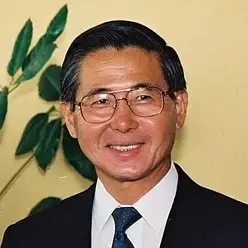
President of Peru (1990–2000)
Fujimori liberalized Peru’s economy, privatized major firms and combined market reforms with targeted anti-poverty programs. He concentrated power in the presidency after closing Congress in 1992, and his government’s counterinsurgency campaign and family planning program were marked by serious abuses. In 1998 he signed the agreement that ended the border dispute with Ecuador.
Key figure of
Closest ideologies
Based on the 66 statements where Alberto Fujimori has a known position.
- Fujimorism (91% match)
- Cultural conservatism (89% match)
- Creole nationalism (88% match)
- New Right (88% match)
- Asian values (88% match)
Similar people
- Marcus Aurelius (89% alike)
- Ahmed al-Sharaa (88% alike)
- William F. Buckley Jr. (88% alike)
- Santiago Peña Palacios (88% alike)
- Simone Weil (87% alike)
Known positions
- Strongly: Elected governments should leave central banks free to make monetary-policy decisions within their legal mandates.
- Strongly: The government should stop its political opponents from organising, speaking or competing for power.
- Strongly: Rulers are not bound to act only under lasting, publicly known laws administered by recognised courts.
- Strongly: There should be legal limits on strike action.
- Strongly: Voters themselves should elect the head of state, without an intermediary body selecting the officeholder.
- Strongly: Government bodies should be specifically responsible for advancing gender equality.
- Strongly: Population growth should be deliberately held down.
- Strongly: Owners' rights to their property should almost never be overridden, even for public goals.
- Strongly: Foreign buyers may be allowed to take over firms in strategic industries.
- Strongly: Real authority to command the military should rest with the head of state.
- Strongly: A national emergency sometimes justifies temporarily withdrawing normal legal safeguards against people the government regards as internal enemies, such as protections against detention without trial.
- Strongly: The country would benefit from a strong leader with the power to act despite deadlock among its political institutions.
- Strongly: Government borrowing should be subject to binding legal limits.
- Strongly: Industries such as energy, rail and utilities do not need to be publicly owned.
- Strongly: An assembly elected by the people for that purpose should draft the constitution.
- Strongly: Abortion should be illegal in most cases.
- Strongly: Past abuses by a state's security forces may be put behind it without anyone answering for them in court.
- Strongly: Private businesses and markets should run most of the economy, while the government supports people who cannot meet their basic needs.
- Strongly: Being a foreigner should not by itself bar someone from owning land in the country.
- Strongly: The directly elected parliament should be a legislature's only chamber.
- Strongly: Democracy is not the best form of government when voters choose badly.
- Strongly: Children of citizens are not the only ones who should be citizens at birth.
- Strongly: A head of state should have the power to dissolve parliament.
- Strongly: Tariffs should not be used to protect domestic industry from foreign competition.
- Strongly: Governments need not restrict how money and investment move across borders.
- Strongly: The state should not make one language the only common language of government, schooling and public life at the cost of limiting others.
- Strongly: Another body may have the final say over what the legislature passes.
- Strongly: Changing how society works can be justified even when it breaks with the institutions already in place.
- Strongly: There should be a central bank.
- Strongly: State ownership should stop short of covering all land.
- Strongly: Central banks should keep a role in controlling the money supply.
- Strongly: Price controls do more harm than good against inflation.
- Strongly: Society needs government of some kind.
- Strongly: Government should have other tasks besides protecting people from physical violence.
- Leans: A country need not reject spending cuts demanded in return for loans.
- Leans: The national church is recognised in law above other religions.
- Leans: People do not have full ownership of their own bodies.
- Leans: Elected representatives may serve out their terms without voters being able to remove them early.
- Leans: New oil and gas wells and coal mines should be permitted.
- Leans: Military service should always be voluntary.
- Leans: Prisons should mainly help offenders rejoin society.
- Leans: The worst crimes can be punished by death.
- Leans: Schools should teach pupils about sex.
- Leans: Businesses should be legally barred from agreements with competitors to suppress competition, such as fixing prices.
- Leans: Judge policies by what they achieve, independently of whether they match an ideology.
- Leans: Some institutional ties between government and religion are acceptable.
- Leans: Creating new money should be reserved to public institutions, excluding private banks' creation of money through lending.
- Leans: An electorate should choose the head of state, either directly or through elected representatives.
- Leans: Countries should accept binding international arbitration of their disputes.
- Leans: Each country should hold ultimate authority over its natural resources, without foreign interests controlling them.
- Leans: Women should be able to vote and stand for office on the same terms as men.
- Leans: Keeping a nation's inherited culture alive, including its language, customs and traditions, matters.
- Leans: Citizens should have a legal right to see government information.
- Leans: Public institutions should help minority languages be used in public life, for example through teaching or services in those languages.
- Leans: Indigenous peoples should control their traditional territories.
- Leans: Most people in political office look after themselves first and the public second.
- Leans: Trade, finance and debt rules should be changed to give poorer countries a fairer share.
- Leans: Meeting poor people's needs should be the first consideration in public policy.
- Leans: People should have a way to vote an officeholder out between regular elections.