Political Ideology Atlas · All ideologies · Take the test
Whiggism
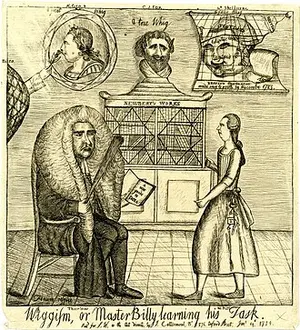
Whiggism is the tradition that defended parliamentary supremacy over royal prerogative, a constitutional monarchy with a Protestant succession, the security of property and the rule of law. It drew on Locke's natural rights and consent theory, justified the Revolution of 1688 as lawful resistance to arbitrary power, and favoured gradual reform led by a propertied elite. Its toleration was limited to Protestant dissenters, and it later merged into nineteenth-century liberalism.
What it stands for
- Only people who own property should have the right to vote.
- Whoever first settles and works unowned land becomes its rightful owner.
- Special ranks held by birth, such as noble titles and hereditary crowns, may continue to exist.
- The national church is recognised in law above other religions.
- The best government combines a governing role for a few with a governing role for the wider population.
- Owners' rights to their property should almost never be overridden, even for public goals.
Key figures
- John Locke: Philosopher whose consent and natural rights theory underpinned Whig justification of 1688.
- Edmund Burke: Whig politician and the theorist of the Old Whig tradition in his Appeal of 1791.
- Thomas Babington Macaulay: Whig politician and historian who gave Whig history its classic form.
Closest ideologies
- Conservatism (89% match)
- Eco-Conservatism (89% match)
- Conservative Liberalism (88% match)
- Compassionate conservatism (87% match)
- Monarchism in Brazil (87% match)
People closest to it
- William Howard Taft (89% alike)
- Mitt Romney (89% alike)
- Rudy Giuliani (88% alike)
- John Adams (87% alike)
- George H. W. Bush (86% alike)
Key positions
- Strongly: Only people who own property should have the right to vote.
- Strongly: Whoever first settles and works unowned land becomes its rightful owner.
- Strongly: Special ranks held by birth, such as noble titles and hereditary crowns, may continue to exist.
- Strongly: The national church is recognised in law above other religions.
- Strongly: The best government combines a governing role for a few with a governing role for the wider population.
- Strongly: Owners' rights to their property should almost never be overridden, even for public goals.
- Strongly: The representative legislature should have the final say on legislation.
- Strongly: Changes to society should be introduced a little at a time.
- Strongly: After members debate and adopt a party decision, those who opposed it should not have to help implement it.
- Strongly: Some of the foreign debts of poor countries should still be repaid.
- Strongly: The nation does not need a radical rebirth to overcome decadence.
- Strongly: Besides its directly elected parliament, a legislature should have a second chamber, such as a senate.
- Strongly: Money creation should not be reserved exclusively to public institutions.
- Strongly: Political power should be split among separate branches and levels that can each limit the others.
- Strongly: Elected officials may receive a salary above what an average worker earns.
- Strongly: A person's body belongs entirely to that person.
- Strongly: Large landed estates should not be compulsorily transferred to the people who farm them.
- Strongly: Major laws should not be decided by direct votes of citizens.
- Strongly: A country may join permanent military alliances.
- Strongly: A country can get through deadlock among its institutions without a leader who overrides them.
- Strongly: Elected representatives may serve out their terms without voters being able to remove them early.
- Strongly: People are entitled to resist a ruler's unconstitutional exercise of power.
- Strongly: An elected legislature must approve the government's budget before the government spends public money.
- Strongly: Direct action does not have to take the place of elections and parliament as the way to achieve political change.
- Strongly: The head of state should not be elected directly by the voters.
- Strongly: Social duty should not take the place of material rewards as the main reason people work.
- Strongly: In the society we should aim for, a person's share of goods may depend on things besides their needs.
- Strongly: Government should rely at least as much on legal enforcement as on its rulers' moral example.
- Strongly: Profit made from owning businesses does not come from exploiting the workers who produce it.
- Strongly: The people who own the economy and hold power are not the ones the state mainly serves.
- Strongly: Rulers must act under lasting, publicly known laws administered by recognised courts.
- Strongly: Historical change does not come mainly from changes in how society produces and exchanges goods.
- Strongly: A person's right to hold land need not end when they stop using it.
- Strongly: Equality of outcomes should not be society's goal.
- Strongly: Rulers have a right to rule only because the people they rule have agreed to it.
- Strongly: The existing governing institutions should be retained, even if their personnel, policies or procedures change.
- Strongly: Other forces move history at least as much as conflict between classes does.
- Strongly: Protecting the constitution should be left to civilian institutions, not the armed forces.
- Strongly: The leader should not bypass political intermediaries in dealing with the people.
- Strongly: A mother country and its colonies may trade with the outside world.
- Strongly: Citizens should not be permitted to choose someone else to cast their votes in a policy area, with separate choices for different areas.
- Strongly: Individual farms should not give way to joint cultivation by groups of farmers.
- Strongly: Poor countries should retain economic ties with rich countries.
- Strongly: Lending money at interest should be legal.
- Strongly: Religion does not offer illusory comfort for material suffering.
- Strongly: Local community ownership of the means of production should not replace private or state ownership.
- Strongly: No party's ideology should give it an exclusive right to lead the state.
- Strongly: Central banks should keep a role in controlling the money supply.
- Strongly: There is no deliberate plan behind immigration aimed at replacing the native population.
- Strongly: No state may force a minority out of the country, however hostile it judges that minority to be.
- Strongly: The vote keeps a government in check at least as well as being able to leave the country does.
- Strongly: Some decisions should bind people who have not consented to them.
- Strongly: A workers' state does not need to suppress the old ruling class, even for a time.
- Strongly: Public offices may be filled by methods other than drawing lots.
- Strongly: Society needs government of some kind.
- Strongly: Countries should keep their armed forces.
- Strongly: The slaughter of cattle should be legal.
- Strongly: The ruler should be subject to the country's laws.
- Strongly: Collecting taxes does not in itself amount to stealing people's money.
- Strongly: Renting out housing should be permitted in at least some circumstances.
- Strongly: Political authority need not rest on oaths of loyalty sworn to a lord.
- Strongly: Killing another person can be right in self-defence or in defence of others.
- Strongly: The holder of the highest state office need not be treated as holy.
- Strongly: State schools need not steer pupils away from belief in God.
- Strongly: Women may go out in public without any legal duty to cover fully.
- Strongly: Courts need not be handed over to private businesses.
- Strongly: Final authority over a state's laws need not belong to its most senior religious scholars.
- Strongly: Suspected drug dealers should never be put to death without a trial.
- Strongly: Museums, libraries and other inherited culture should not be destroyed, even when they stand in the way of new creation.
- Strongly: Humanity would gain nothing by going back to living off hunting and gathering.
- Strongly: Farmers should have the legal freedom to leave the estates they work.
- Leans: Colonies should be run mainly to supply markets, materials and outlets for the ruling country.
- Leans: Belonging to the nation goes with sharing its religion.
- Leans: The country's majority national group should have the leading role in controlling economic life.
- Leans: Private property does not need to serve the common good to be justified.
- Leans: It is acceptable for a monarch who inherits the throne to be the country's symbolic head while others govern.
- Leans: Some people are better suited by nature to govern.
- Leans: People do not need a direct role in making decisions where they work, live and study.
- Leans: The government should have authority over religious institutions' internal affairs.
- Leans: Prices and competition generally decide better than officials what gets made and who gets it.
- Leans: The head of state should not have to be chosen by election.
- Leans: What matters is how people came by their wealth, not how evenly it ends up shared.
- Leans: Elected officials should serve out their full terms.
- Leans: Believers can be excused from rules, such as dress or work-day rules, that conflict with their faith.
- Leans: Religious communities may be a basis for political life, as when parties represent one faith and top offices are shared out between faiths.
- Leans: The national parliament stays the final authority and can take powers back from the regions.
- Leans: Individual rights matter at least as much as what citizens owe their community.
- Leans: Democracy is not the best form of government when voters choose badly.
- Leans: The state may give legal precedence to one stream of a religion over the others.
- Leans: Military service should always be voluntary.
- Leans: My country's military strength should exceed that of its rivals.
- Leans: Laws, institutions and customs today do not systematically favor men over women.
- Leans: Politics should give compromises among competing groups at least as much weight as a single common good identified by reasoning.
- Leans: Seeking equal rights in their countries of residence should take priority over leaving to establish a homeland as the response to persecution.
- Leans: Allies are bound to defend one another against armed attack.
- Leans: Women's equality can be fully achieved without transforming the economic system.
- Leans: Government borrowing should be free of binding legal limits.
- Leans: What things are worth comes from the work put into them.
- Leans: Some institutional ties between government and religion are acceptable.
- Leans: People outside state forces should also be allowed to bear arms.
- Leans: Government should serve people's good while respecting each person as more than an instrument of the state or community.
- Leans: Real command of the military may rest with someone other than the head of state.
- Leans: People must be free to leave their religion without legal penalty.
- Leans: Ideas of what men and women are like do not come mostly from culture.
- Leans: A constitution does not have to be drafted by an assembly elected for that purpose.
- Leans: Human rights come from the nature that all human beings share.
- Leans: Sex work between consenting adults should be illegal.
- Leans: A nation need not wait for a cultural revival before building its state.
- Leans: Some things are right or wrong for everyone, in every culture and era.
- Leans: A person loses freedom from being at another person's mercy, even if that power is never exercised.
- Leans: How someone turns out is shaped more by upbringing, society and experience than by the traits they are born with.
- Leans: Government should have other tasks besides protecting people from physical violence.
- Leans: Where they conflict, religious faith should count for at least as much as evidence and reasoning.
- Leans: Political representation should not come through social bodies such as families, local communities and occupational associations instead of political parties.
- Leans: Public institutions should have the power to constrain a national majority's decisions in a liberal democracy.
- Leans: Being the law gives a rule a moral claim to be obeyed.
- Leans: Restoring a lost social order does not matter more than pursuing progress.
- Leans: Art should not be censored for its effect on people's moral character.
- Leans: Religious conversion should be free of legal restriction.
- Leans: Keeping a nation's inherited culture alive, including its language, customs and traditions, matters.
- Leans: We have a duty to leave the planet in good condition for those who come after us.
- Leans: At least some revolutions have been justified.
- Leans: Political violence is sometimes justified.
- Leans: Laws should not be required to follow religious texts.
- Leans: Political authority does not ultimately come from God.
- Leans: Being the first to use force can be right, depending on what it is meant to achieve.
- Leans: School history should mostly tell the story of the student's own nation.
- Leans: The law should treat everyone as an equal, whatever their birth, sex, race or status.