Political Ideology Atlas · All ideologies · Take the test
Kurdish-Islamic nationalism
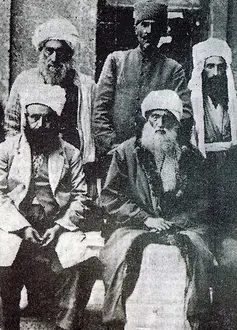
Kurdish-Islamic nationalism fuses Kurdish national identity with Islamism, opposing the secular nationalism of mainstream Kurdish politics and of Kemalist and Ba'athist states. It seeks Kurdish self-determination, with sharia as the basis of law and Islam central to public life. Its strands range from sheikh-led revolt (Sheikh Said) and jihadist groups (Ansar al-Islam, Mullah Krekar) to electoral parties such as the IMK and KIU.
What it stands for
- The state should punish people who publicly insult what a religion holds sacred.
- Same-sex relations between consenting adults should be punishable by law.
- Laws should follow religious texts.
- God is the ultimate source of the right to exercise political authority.
- Every Muslim is obliged to take part in armed resistance against such an invasion.
- The holy scripture of one's faith is God's own word and contains no errors.
Key figures
- Sheikh Said: Led the 1925 Kurdish rebellion against Turkey, the movement's founding figure per the Wikipedia article
- Mullah Krekar: Founder of Ansar al-Islam and a leading ideologue of Kurdish-Islamic nationalism
Closest ideologies
- Islamic nationalism (91% match)
- Islamic fundamentalism (89% match)
- Confucianism (89% match)
- Familialism (88% match)
- Islamism (88% match)
People closest to it
- Muhammad (89% alike)
- Aristotle (87% alike)
- Anna Paulina Luna (87% alike)
- Ali Khamenei (86% alike)
- Henry Ford (86% alike)
Key positions
- Strongly: The state should punish people who publicly insult what a religion holds sacred.
- Strongly: Same-sex relations between consenting adults should be punishable by law.
- Strongly: Laws should follow religious texts.
- Strongly: God is the ultimate source of the right to exercise political authority.
- Strongly: Every Muslim is obliged to take part in armed resistance against such an invasion.
- Strongly: The holy scripture of one's faith is God's own word and contains no errors.
- Strongly: Marriage, inheritance and family law may differ between religious communities.
- Strongly: Religious values and institutions should shape laws, schools and public life.
- Strongly: A woman who has sex outside marriage is doing something wrong.
- Strongly: Some institutional ties between government and religion are acceptable.
- Strongly: The law should limit the making or sale of pornography.
- Strongly: Armed forces may refuse to let gay people serve openly.
- Strongly: Recreational drugs should be illegal for adults.
- Strongly: At least some religious leadership offices should have different eligibility rules for women than for men.
- Strongly: Sex work between consenting adults should be illegal.
- Strongly: The state should not make one language the only common language of government, schooling and public life at the cost of limiting others.
- Strongly: State institutions may allow visible religious dress for staff and pupils.
- Strongly: Religious institutions should be independent of government direction in their internal affairs.
- Strongly: Where they conflict, religious faith should count for at least as much as evidence and reasoning.
- Strongly: Transgender people's legal gender should not be based on their gender identity.
- Strongly: People who give their lives for the nation deserve to be remembered as martyrs, with reverence beyond ordinary thanks.
- Strongly: A healthy society depends on the traditional family, such as a married mother and father raising their children.
- Strongly: The law should not extend marriage to same-sex couples.
- Strongly: Religion has not been a leading cause of women being kept in a lower position.
- Strongly: Historical change does not come mainly from changes in how society produces and exchanges goods.
- Strongly: The state may restrict what adults do for reasons other than preventing harm to others.
- Strongly: Families may keep the main responsibility for housework and childcare.
- Strongly: Whether a religious text promotes women's full humanity should not be a standard for judging that text.
- Strongly: Other forces move history at least as much as conflict between classes does.
- Strongly: The great religions need not share a single underlying truth.
- Strongly: Politics should support people's spiritual well-being.
- Strongly: Grown children owe care to parents who need it.
- Strongly: Being the first to use force can be right, depending on what it is meant to achieve.
- Strongly: Classifying people by sex tracks differences that exist whatever society says.
- Strongly: Workers do not need a disciplined revolutionary party to lead them.
- Strongly: Religion does not offer illusory comfort for material suffering.
- Strongly: Political power may rest on something other than workplace-elected councils.
- Strongly: Keeping a nation's inherited culture alive, including its language, customs and traditions, matters.
- Strongly: Small, informal, trust-based groups should not take the place of lasting parties, unions and federations in political action.
- Strongly: Work may stay divided into separate specialized jobs held by different people.
- Strongly: In the long run people should still produce and share using money.
- Strongly: People of different races should not be discouraged from forming a family together, including through marriage and children.
- Strongly: No society has the right to rule another for its supposed improvement, however advanced it is.
- Strongly: Marriage should retain legal recognition.
- Strongly: Some decisions should bind people who have not consented to them.
- Strongly: A workers' state does not need to suppress the old ruling class, even for a time.
- Strongly: Public offices may be filled by methods other than drawing lots.
- Strongly: Society needs government of some kind.
- Strongly: Countries should keep their armed forces.
- Strongly: The slaughter of cattle should be legal.
- Strongly: The ruler should be subject to the country's laws.
- Strongly: Public policy should not be used to reduce the passing on of inherited disabilities.
- Strongly: Voting should not be limited to members of one ethnic group.
- Strongly: Killing another person can be right in self-defence or in defence of others.
- Strongly: Overseas territories need not be run mainly for the ruling country's economic benefit.
- Strongly: The holder of the highest state office need not be treated as holy.
- Strongly: Taking part in politics is at least as good a way to live as living privately away from public affairs.
- Strongly: A weaker state need not formally treat a stronger power as its superior.
- Strongly: People without property should also have the right to vote.
- Strongly: State schools need not steer pupils away from belief in God.
- Strongly: Public spaces such as schools and facilities should not be separated by race under the law.
- Strongly: Museums, libraries and other inherited culture should not be destroyed, even when they stand in the way of new creation.
- Strongly: Humanity would gain nothing by going back to living off hunting and gathering.
- Strongly: Farmers should have the legal freedom to leave the estates they work.
- Leans: Abandoning the faith is a crime that the state may punish.
- Leans: The most senior religious scholars should have the highest authority over the state and its laws.
- Leans: Women should be legally obliged to cover themselves fully whenever they are in public.
- Leans: Charging interest on loans is banned by law.
- Leans: Belonging to the nation goes with sharing its religion.
- Leans: Recovering how society used to be matters more than moving forward.
- Leans: The presence of people belonging to the same nation gives a state a legitimate territorial claim outside its borders.
- Leans: A region should be entitled to leave its current country.
- Leans: At its core, politics is a struggle between spiritual good and evil.
- Leans: The national church is recognised in law above other religions.
- Leans: Government should depend more on leaders setting a good example than on enforcing laws with penalties.
- Leans: Defense should rest with armed ordinary citizens, not a standing force.
- Leans: A country should press its neighbour to give back land taken from it in an old war.
- Leans: The state may give legal precedence to one stream of a religion over the others.
- Leans: Speaking a common language is sufficient for people to constitute one nation.
- Leans: Inherited religious teachings may stay as handed down, without being rethought for present conditions.
- Leans: State schools may teach pupils a religious faith, for example through lessons in its beliefs and practice.
- Leans: A country does not have the right to stop a region becoming independent by using its military.
- Leans: The worst crimes can be punished by death.
- Leans: The nation has decayed and must be reborn.
- Leans: People outside state forces should also be allowed to bear arms.
- Leans: Areas where an ethnic minority makes up most of the population should be able to run many of their own affairs within the state.
- Leans: Countries that feel dominated by Western powers should band together to resist them.
- Leans: A people should have one region of its own rather than being split across several.
- Leans: Society may be changed in large, rapid steps.
- Leans: An ancestral bond to a land gives a people a claim that outweighs the claims of other peoples who now live there.
- Leans: Land that a state declares its own against its people's will is still illegally occupied by that state.
- Leans: Some cultures are superior to others.
- Leans: Government should have other tasks besides protecting people from physical violence.
- Leans: Today, nobody is bound by a colonial-era treaty that divided a people without asking them.
- Leans: A single fixed definition of women is an acceptable foundation for feminist politics.
- Leans: Political institutions developed in the West are not a suitable model for every civilization.
- Leans: Peoples who share an ethnic heritage, such as the Slavic peoples, should not come together in one state.
- Leans: The subordination of women and human mastery over nature can be understood as separate matters.
- Leans: Rules need not set equal numbers of women and men on public bodies.
- Leans: A people split by an imposed border should be brought together in a single state.
- Leans: A state should take responsibility for the welfare of its national communities across neighbouring borders.
- Leans: The vote keeps a government in check at least as well as being able to leave the country does.
- Leans: Wages need not be set through negotiating bodies that the state officially recognizes.
- Leans: Most people in political office look after themselves first and the public second.
- Leans: Racial groups should not each organise to defend distinct political interests of their own.
- Leans: An economy directed by a central plan is not capable of working better than one directed by market exchange.
- Leans: No party's ideology should give it an exclusive right to lead the state.
- Leans: At least some revolutions have been justified.
- Leans: Political violence is sometimes justified.
- Leans: The government should let its political opponents organise, speak and compete for power.
- Leans: Protecting the constitution should be left to civilian institutions, not the armed forces.
- Leans: A people's connection to its ancestral land is spiritual, beyond practical interests or ordinary affection.
- Leans: The leader should not bypass political intermediaries in dealing with the people.
- Leans: Most of the average difference in ability between racial groups does not come from genes.
- Leans: Groups have rights of their own.
- Leans: The law should treat everyone as an equal, whatever their birth, sex, race or status.