Political Ideology Atlas · All ideologies · Take the test
Federalism
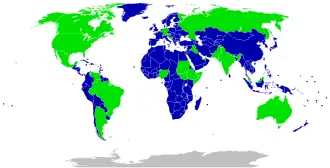
Federalism is the theory and advocacy of dividing final authority between member units and common institutions, usually in an entrenched constitution that neither level can alter alone. Its founding arguments hold that this double division, together with checks inside each government and an extended union of many interests, restrains rulers and majorities, lets diverse communities govern themselves, and secures defence and commerce at the centre. It is a structural doctrine and speaks to few questions outside the form and limits of government.
What it stands for
- Besides its directly elected parliament, a legislature should have a second chamber, such as a senate.
- Political power should be split among separate branches and levels that can each limit the others.
- Major laws should not be decided by direct votes of citizens.
- The national legislature should not be able to take back powers given to regions on its own.
- Local communities should not tie their joint councils to merely carrying out what local assemblies decide.
- People are entitled to resist a ruler's unconstitutional exercise of power.
Key figure
- Johannes Althusius: Early modern thinker the Stanford entry calls the father of modern federalist thought.
Closest ideologies
- Neo-Ottomanism (94% match)
- Centrism (94% match)
- Islamic modernism (94% match)
- Economic liberalism (94% match)
- Progressive conservatism (93% match)
People closest to it
- Bill Kristol (93% alike)
- Alexis de Tocqueville (92% alike)
- Francis Fukuyama (92% alike)
- John Quincy Adams (92% alike)
- Michael Heseltine (91% alike)
Key positions
- Strongly: Besides its directly elected parliament, a legislature should have a second chamber, such as a senate.
- Strongly: Political power should be split among separate branches and levels that can each limit the others.
- Strongly: Major laws should not be decided by direct votes of citizens.
- Strongly: The national legislature should not be able to take back powers given to regions on its own.
- Strongly: Local communities should not tie their joint councils to merely carrying out what local assemblies decide.
- Strongly: People are entitled to resist a ruler's unconstitutional exercise of power.
- Strongly: Rulers have a right to rule only because the people they rule have agreed to it.
- Strongly: Equality of outcomes should not be society's goal.
- Strongly: The government should let its political opponents organise, speak and compete for power.
- Strongly: Public institutions should have the power to constrain a national majority's decisions in a liberal democracy.
- Strongly: No party's ideology should give it an exclusive right to lead the state.
- Strongly: Some decisions should bind people who have not consented to them.
- Strongly: Society needs government of some kind.
- Strongly: The ruler should be subject to the country's laws.
- Strongly: Final authority over a state's laws need not belong to its most senior religious scholars.
- Leans: Having a shared national identity does not by itself entitle a people to its own self-governing state.
- Leans: Countries should hand part of their decision-making power to a union of nations, such as the European Union.
- Leans: Owners' rights to their property should almost never be overridden, even for public goals.
- Leans: Politics should give compromises among competing groups at least as much weight as a single common good identified by reasoning.
- Leans: Countries are better off sharing one currency than each having its own.
- Leans: Delegates selected by councils at one level should select officeholders at higher levels.
- Leans: A national minority should run its own schools, language and cultural institutions inside the state it lives in.
- Leans: Areas where an ethnic minority makes up most of the population should be able to run many of their own affairs within the state.
- Leans: A country may keep a region that wants to leave.
- Leans: A nation can be made up of several ethnic groups with none forming most of its people.
- Leans: Political decisions should rest with the smallest local community able to handle them, with wider authorities handling matters that need a wider reach.
- Leans: Some areas of life should remain outside state direction.
- Leans: In law, a country's traditional national church should rank no higher than other religious bodies.
- Leans: Religious institutions should be independent of government direction in their internal affairs.
- Leans: Laws should not be required to follow religious texts.