Political Ideology Atlas · All people · Take the test
Europe · born 1802, historical
Victor Hugo
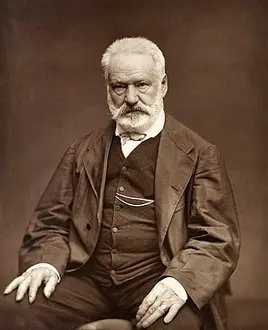
French novelist, peer, republican deputy and senator (1802-1885)
Hugo moved from royalism to a republicanism that joined universal suffrage and free press with lay free schooling, abolition of the death penalty, public relief and a federal United States of Europe. He opposed Louis Bonaparte's coup and lived in exile for nearly twenty years, defended property while wanting it spread to workers, and backed colonisation as a duty of tutelage for 'elder' peoples.
Closest ideologies
Based on the 68 statements where Victor Hugo has a known position.
- Pro-Europeanism (92% match)
- Clintonism (91% match)
- Liberalism in the United States (91% match)
- Revisionism (90% match)
- Liberal Socialism (89% match)
Similar people
- Al Gore (91% alike)
- Benazir Bhutto (91% alike)
- John Rawls (91% alike)
- Howard Dean (90% alike)
- Mikie Sherrill (90% alike)
Known positions
- Strongly: Temporary rule by a more developed society is justified when it helps the ruled to progress.
- Strongly: Countries should hand part of their decision-making power to a union of nations, such as the European Union.
- Strongly: Fewer tariffs and trade barriers make all countries better off over time.
- Strongly: Countries are better off sharing one currency than each having its own.
- Strongly: Government should maintain a strict institutional separation from religion.
- Strongly: The state should be barred from executing people convicted of the gravest crimes, such as terrorism.
- Strongly: Working together internationally should count at least as much as my country's own priorities.
- Strongly: The state should offer public work to anyone who wants a job and cannot find one.
- Strongly: Religious values and institutions should not have a major part in shaping laws, schools and public life.
- Strongly: State schools should not teach religion.
- Strongly: Property should belong to many people in small holdings.
- Strongly: Prisons should mainly help offenders rejoin society.
- Strongly: Tariffs should not be used to protect domestic industry from foreign competition.
- Strongly: Laws, institutions and customs still favor men over women.
- Strongly: Foreign powers sometimes have a right to intervene in a country's internal affairs.
- Strongly: Military intervention abroad is sometimes necessary to protect human rights.
- Strongly: Democracy is best even when voters make poor choices.
- Strongly: A country can get through deadlock among its institutions without a leader who overrides them.
- Strongly: Land that a state declares its own against its people's will is still illegally occupied by that state.
- Strongly: People are entitled to resist a ruler's unconstitutional exercise of power.
- Strongly: Some cultures are superior to others.
- Strongly: An electorate should choose the head of state, either directly or through elected representatives.
- Strongly: Restoring a lost social order does not matter more than pursuing progress.
- Strongly: Rulers have a right to rule only because the people they rule have agreed to it.
- Strongly: Even a purely ceremonial head of state should not hold the position by birth.
- Strongly: Art should not be censored for its effect on people's moral character.
- Strongly: The law should not assign different roles in public life on the basis of sex.
- Strongly: Whatever their circumstances, everyone should be able to count on the state for enough to live decently, through benefits, pensions or public services.
- Strongly: War does not strengthen a nation's character.
- Strongly: Political violence is sometimes justified.
- Strongly: A people with a shared national identity is entitled to its own self-governing state.
- Strongly: Being powerful does not mean a country should bring more land within its borders.
- Strongly: Protecting the constitution should be left to civilian institutions, not the armed forces.
- Strongly: The law should treat everyone as an equal, whatever their birth, sex, race or status.
- Strongly: At least some revolutions have been justified.
- Strongly: News media should decide for themselves what they publish, whoever holds power.
- Strongly: No party's ideology should give it an exclusive right to lead the state.
- Strongly: Some areas of life should remain outside state direction.
- Strongly: Society needs government of some kind.
- Strongly: The ruler should be subject to the country's laws.
- Strongly: Government should have other tasks besides protecting people from physical violence.
- Strongly: Collecting taxes does not in itself amount to stealing people's money.
- Strongly: The holder of the highest state office need not be treated as holy.
- Strongly: Taking part in politics is at least as good a way to live as living privately away from public affairs.
- Strongly: Final authority over a state's laws need not belong to its most senior religious scholars.
- Strongly: Museums, libraries and other inherited culture should not be destroyed, even when they stand in the way of new creation.
- Leans: In the long run people should be free to live and work in any country.
- Leans: Spreading our political system abroad should be a special calling of our nation.
- Leans: The UN should have authority to compel member states to comply with its decisions.
- Leans: The same income-tax percentage should apply across taxable income levels.
- Leans: The government should have authority over religious institutions' internal affairs.
- Leans: Owners' rights to their property should almost never be overridden, even for public goals.
- Leans: The representative legislature should have the final say on legislation.
- Leans: An assembly elected by the people for that purpose should draft the constitution.
- Leans: A country should press its neighbour to give back land taken from it in an old war.
- Leans: Government should be bound by written guarantees of basic rights protected against easy amendment by ordinary majorities.
- Leans: Political decisions should rest with the smallest local community able to handle them, with wider authorities handling matters that need a wider reach.
- Leans: Some things are right or wrong for everyone, in every culture and era.
- Leans: You can't reach a free, fair society by unfree or unfair means.
- Leans: Employers and workers should treat each other as partners whose cooperation comes before conflict, even where their interests differ.
- Leans: Meeting poor people's needs should be the first consideration in public policy.
- Leans: Equality of outcomes should not be society's goal.
- Leans: Other things drive humanity forward at least as much as rivalry and conflict between peoples.
- Leans: Other forces move history at least as much as conflict between classes does.