Political Ideology Atlas · All people · Take the test
Latin America & Caribbean · born 1878, historical
Pancho Villa
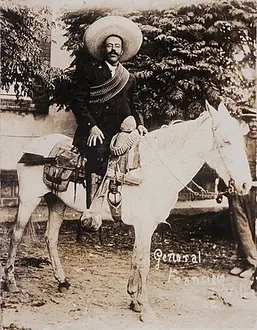
Mexican revolutionary commander and provisional governor of Chihuahua (1913–1914)
Villa fought in the Mexican Revolution and led the División del Norte. In Chihuahua he confiscated estates from powerful landowners. His 1915 agrarian law called for state governments to break up large holdings and transfer plots to cultivators.
Closest ideologies
Based on the 39 statements where Pancho Villa has a known position.
- Völkisch movement (90% match)
- Neo-Nazism (90% match)
- Hindu nationalism (89% match)
- Right-wing populism (88% match)
- Ethnocacerism (87% match)
Similar people
- Syngman Rhee (89% alike)
- Oswald Mosley (89% alike)
- Nick Fuentes (88% alike)
- Viktor Orbán (88% alike)
- Osama bin Laden (87% alike)
Known positions
- Strongly: A state may force a minority it sees as hostile to leave the country.
- Strongly: Voters themselves should elect the head of state, without an intermediary body selecting the officeholder.
- Strongly: Governments should set legal price ceilings on essential foods when supplies are scarce.
- Strongly: A national emergency sometimes justifies temporarily withdrawing normal legal safeguards against people the government regards as internal enemies, such as protections against detention without trial.
- Strongly: Land stays in the hands of citizens; foreigners may not buy it.
- Strongly: To keep their political freedoms, people need the freedom to own property, trade and choose their work.
- Strongly: The government should be able to require citizens to serve in the military.
- Strongly: Property should belong to many people in small holdings.
- Strongly: The farmers who work large estates should take ownership from the landowners, with the transfer compulsory if owners refuse.
- Strongly: An electorate should choose the head of state, either directly or through elected representatives.
- Strongly: Owners' rights to their property need not be protected against being overridden for public goals.
- Strongly: People are entitled to resist a ruler's unconstitutional exercise of power.
- Strongly: Individual farms should not give way to joint cultivation by groups of farmers.
- Strongly: Rulers have a right to rule only because the people they rule have agreed to it.
- Strongly: Equality of outcomes should not be society's goal.
- Strongly: State ownership should stop short of covering all land.
- Strongly: Very large concentrations of wealth threaten a free society.
- Strongly: Armed resistance to a foreign military occupation is justified.
- Strongly: Society needs government of some kind.
- Strongly: Countries should keep their armed forces.
- Strongly: Government should have other tasks besides protecting people from physical violence.
- Strongly: People without property should also have the right to vote.
- Leans: During an armed conflict, it can be acceptable to aim attacks directly at civilians on the opposing side.
- Leans: The law should not impose a blanket ban on torture.
- Leans: The law may treat people differently according to such things as birth, sex, race and status.
- Leans: The government should stop its political opponents from organising, speaking or competing for power.
- Leans: Rulers are not bound to act only under lasting, publicly known laws administered by recognised courts.
- Leans: The worst crimes can be punished by death.
- Leans: Political power should be split among separate branches and levels that can each limit the others.
- Leans: Direct action does not have to take the place of elections and parliament as the way to achieve political change.
- Leans: Some institutional ties between government and religion are acceptable.
- Leans: Industries such as energy, rail and utilities should be owned by the state or public bodies, not private companies.
- Leans: Courts need not be handed over to private businesses.
- Leans: Women should be able to vote and stand for office on the same terms as men.
- Leans: Political decisions should rest with the smallest local community able to handle them, with wider authorities handling matters that need a wider reach.
- Leans: Basic local services, such as water, hospitals and local transport, should be publicly owned and run.
- Leans: A person loses freedom from being at another person's mercy, even if that power is never exercised.
- Leans: People who give their lives for the nation deserve to be remembered as martyrs, with reverence beyond ordinary thanks.
- Leans: Meeting poor people's needs should be the first consideration in public policy.