Political Ideology Atlas · All people · Take the test
North America · born 1912, historical
Milton Friedman
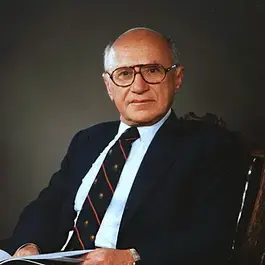
American economist (1912–2006), Nobel laureate and free-market advocate
An economist who argued for limited government, free markets and free trade, a legislated rule for money in place of discretionary central banking, school vouchers and a negative income tax in place of the welfare system. He opposed minimum wages, price controls, licensure, conscription, farm supports and compulsory social security, and defended voluntary exchange as the basis of political freedom.
Key figure of
Closest ideologies
Based on the 57 statements where Milton Friedman has a known position.
- Austrian school of economics (94% match)
- Fusionism (92% match)
- Classical liberalism (92% match)
- Chicago school of economics (92% match)
- Equity feminism (91% match)
Similar people
- Rand Paul (93% alike)
- Voltaire (87% alike)
- Peter Thiel (85% alike)
- Ron Paul (85% alike)
- María Corina Machado (85% alike)
Known positions
- Strongly: Private owners should be free to refuse association, employment or service on any grounds, including discriminatory ones.
- Strongly: Income may reward the mere ownership of property.
- Strongly: The same income-tax percentage should apply across taxable income levels.
- Strongly: One cash payment, withdrawn gradually as income grows, should replace separate welfare programs.
- Strongly: Public education money should follow the child to whichever school the family picks.
- Strongly: The state should not guarantee health care to everyone.
- Strongly: Labor unions do not necessarily make workers better off.
- Strongly: Public higher education should not be universally tuition-free.
- Strongly: Rules on how corporations operate may be light.
- Strongly: Prices and competition generally decide better than officials what gets made and who gets it.
- Strongly: Individual rights matter at least as much as what citizens owe their community.
- Strongly: Opening markets across borders leaves every trading country better off over time.
- Strongly: Government borrowing should be subject to binding legal limits.
- Strongly: Industries such as energy, rail and utilities do not need to be publicly owned.
- Strongly: Tax rates should not rise steeply with income.
- Strongly: Elected politicians should serve only a small number of terms.
- Strongly: The government may leave it to investors to decide which industries receive investment.
- Strongly: Society does not need a third course beyond capitalism and communism.
- Strongly: The legal minimum wage need not be enough for a full-time worker to live on.
- Strongly: Military service should always be voluntary.
- Strongly: Adults may legally buy and use drugs such as cannabis, possibly with regulation.
- Strongly: To keep their political freedoms, people need the freedom to own property, trade and choose their work.
- Strongly: Farmers should not be given state protection against swings in the prices they receive.
- Strongly: A business owner can earn a profit without taking unfair advantage of employees.
- Strongly: Government should serve people's good while respecting each person as more than an instrument of the state or community.
- Strongly: In the society we should aim for, a person's share of goods may depend on things besides their needs.
- Strongly: Tariffs should not be used to protect domestic industry from foreign competition.
- Strongly: Governments should not fix maximum prices for essential foods, even in times of scarcity.
- Strongly: Governments need not restrict how money and investment move across borders.
- Strongly: Political decisions should rest with the smallest local community able to handle them, with wider authorities handling matters that need a wider reach.
- Strongly: Hate speech should be legal.
- Strongly: A country need not treat an excess of exports over imports as something to aim for.
- Strongly: Rents should be left uncapped by law in areas of housing shortage.
- Strongly: Equality of outcomes should not be society's goal.
- Strongly: The law should treat everyone as an equal, whatever their birth, sex, race or status.
- Strongly: An economy directed by a central plan is not capable of working better than one directed by market exchange.
- Strongly: Elected governments need not leave monetary policy to central banks acting on their own.
- Strongly: Society needs government of some kind.
- Strongly: Public spaces such as schools and facilities should not be separated by race under the law.
- Strongly: Government should have other tasks besides protecting people from physical violence.
- Strongly: Courts need not be handed over to private businesses.
- Leans: Retirement benefits should come from each worker's own privately managed savings account in place of a state scheme using current contributions to pay current retirees.
- Leans: A free society can coexist with very large concentrations of wealth.
- Leans: Choices that harm no one else should never be crimes.
- Leans: Publicly funded services such as hospitals and schools should be run by private companies and charities as well as the state.
- Leans: Owners' rights to their property should almost never be overridden, even for public goals.
- Leans: Believers can be excused from rules, such as dress or work-day rules, that conflict with their faith.
- Leans: Private businesses and markets should run most of the economy, while the government supports people who cannot meet their basic needs.
- Leans: Government should be bound by written guarantees of basic rights protected against easy amendment by ordinary majorities.
- Leans: Making polluters pay a tax protects the environment more than setting rules for them does.
- Leans: Political power should be split among separate branches and levels that can each limit the others.
- Leans: Countries should maintain only the weapons needed for national safety.
- Leans: Capitalism built the productive power and wealth that later and better societies rest on.
- Leans: Governments should not borrow heavily, spending much more than they collect in taxes, to boost the economy.
- Leans: Countries should start from a policy of staying out of other countries' internal affairs.
- Leans: Central banks should keep a role in controlling the money supply.
- Leans: When people's freedom to do something harms the environment, protecting the environment should not take priority over that freedom.