Political Ideology Atlas · All people · Take the test
North America · born 1917, historical
John F. Kennedy
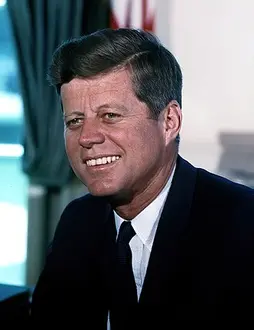
U.S. senator from Massachusetts (1953-1960) and 35th U.S. president (1961-1963)
Kennedy was a Cold War liberal Democrat who combined an expansionist, growth-oriented economic program (tax cuts, aid to education, health insurance for the aged) with firm anti-communism, a large military and alliance system, and support for arms control. He defended absolute separation of church and state, proposed ending the national-origins immigration quotas, and by 1963 championed federal civil rights legislation as a moral issue.
Closest ideologies
Based on the 67 statements where John F. Kennedy has a known position.
- Clintonism (94% match)
- Pro-Europeanism (93% match)
- Liberalism in the United States (90% match)
- Gaitskellism (90% match)
- Revisionism (89% match)
Similar people
- Mark Carney (93% alike)
- Keir Starmer (92% alike)
- Andy Burnham (91% alike)
- Bill Clinton (91% alike)
- Thomas Suozzi (91% alike)
Known positions
- Strongly: Judge policies by what they achieve, independently of whether they match an ideology.
- Strongly: My country may join a military alliance led by one of the great powers.
- Strongly: My country's military strength should exceed that of its rivals.
- Strongly: Government should maintain a strict institutional separation from religion.
- Strongly: Distance and nationality do not weaken the duty of the rich to help the poor abroad.
- Strongly: Allies are bound to defend one another against armed attack.
- Strongly: A country with nuclear weapons should keep them for as long as its rivals retain theirs.
- Strongly: Foreign powers sometimes have a right to intervene in a country's internal affairs.
- Strongly: The state should treat all streams and interpretations of a religion equally under the law.
- Strongly: A country may join permanent military alliances.
- Strongly: Society may be changed in large, rapid steps.
- Strongly: Parties and offices should cut across religious lines.
- Strongly: Direct action does not have to take the place of elections and parliament as the way to achieve political change.
- Strongly: Workers are better off for having labor unions.
- Strongly: In law, a country's traditional national church should rank no higher than other religious bodies.
- Strongly: A nation does not need one main ethnic group: it can be made up of people of many ancestries.
- Strongly: Equality of outcomes should not be society's goal.
- Strongly: Racism is still the main obstacle to the advancement of disadvantaged racial groups.
- Strongly: Income-tax percentages may differ between income levels.
- Strongly: Economic growth should not be limited for the sake of the environment.
- Strongly: A people with a shared national identity is entitled to its own self-governing state.
- Strongly: Being powerful does not mean a country should bring more land within its borders.
- Strongly: The law should treat everyone as an equal, whatever their birth, sex, race or status.
- Strongly: Belonging to the nation does not go with sharing its religion.
- Strongly: Laws should not be required to follow religious texts.
- Strongly: No party's ideology should give it an exclusive right to lead the state.
- Strongly: Publicly insulting a religion's sacred beliefs should be left outside the criminal law.
- Strongly: Private owners' choice of whom they deal with should be subject to some restrictions.
- Strongly: No society has the right to rule another for its supposed improvement, however advanced it is.
- Strongly: Society needs government of some kind.
- Strongly: Countries should keep their armed forces.
- Strongly: Government should have other tasks besides protecting people from physical violence.
- Strongly: Voting should not be limited to members of one ethnic group.
- Strongly: Overseas territories need not be run mainly for the ruling country's economic benefit.
- Strongly: Public spaces such as schools and facilities should not be separated by race under the law.
- Strongly: Final authority over a state's laws need not belong to its most senior religious scholars.
- Strongly: People must be free to leave their religion without legal penalty.
- Leans: My country should give weapons to foreign insurgents fighting governments it regards as enemies.
- Leans: The UN should have authority to compel member states to comply with its decisions.
- Leans: Specialists should have more weight in decisions than public opinion.
- Leans: Countries should hand part of their decision-making power to a union of nations, such as the European Union.
- Leans: Prices and competition generally decide better than officials what gets made and who gets it.
- Leans: A country should be ready to use military force abroad on its own judgment, even if the UN Security Council has not authorized it.
- Leans: Fewer tariffs and trade barriers make all countries better off over time.
- Leans: Government bodies should be specifically responsible for advancing gender equality.
- Leans: Public higher education should not be universally tuition-free.
- Leans: A poor country should rely on foreign money at least as much as on its own resources.
- Leans: Spreading humanity into space should be one of the main things civilization works toward.
- Leans: The country may allow more immigration than strict limits would permit.
- Leans: Governments may spend well beyond their tax revenue to support a weak economy.
- Leans: Tax rates should not rise steeply with income.
- Leans: Religious values and institutions should not have a major part in shaping laws, schools and public life.
- Leans: Countries should maintain only the weapons needed for national safety.
- Leans: Political power should be split among separate branches and levels that can each limit the others.
- Leans: Tariffs should not be used to protect domestic industry from foreign competition.
- Leans: Governments need not restrict how money and investment move across borders.
- Leans: Full-time work at the legal wage floor should pay enough to meet basic living costs.
- Leans: Society should take active steps to make up for the harm done by past racial injustices.
- Leans: Government should impose strict rules on how corporations operate.
- Leans: Private charity does not help people in poverty better than government programs do.
- Leans: A people split by an imposed border should be brought together in a single state.
- Leans: Meeting poor people's needs should be the first consideration in public policy.
- Leans: Public schooling money may go straight to schools instead of to parents as vouchers.
- Leans: A country may leave other nations to choose their own political systems.