Political Ideology Atlas · All people · Take the test
North America · born 1924, historical
Jimmy Carter
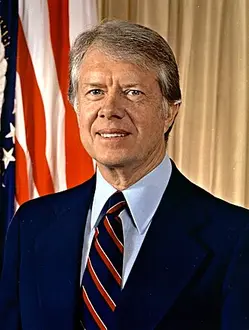
39th President of the United States (1977–1981); governor of Georgia; Nobel Peace laureate (2002)
A Georgia Democrat and born-again Baptist who governed as a fiscally cautious centrist: he deregulated airlines and trucking and aimed at balanced budgets while backing energy conservation, environmental protection, affirmative action and the Equal Rights Amendment. His foreign policy centered on human rights, arms control and negotiated peace (Camp David, Panama treaties, SALT II), with a hardening after the Soviet invasion of Afghanistan. After office he opposed the death penalty and the Iraq War, supported women's equality in religion, criticized money in politics and Israeli policy in the West Bank.
Closest ideologies
Based on the 80 statements where Jimmy Carter has a known position.
- Social Liberalism (93% match)
- Pro-Europeanism (92% match)
- Pragmatism (92% match)
- Liberalism in the United States (90% match)
- Jewish Autonomism (90% match)
Similar people
- John Rawls (94% alike)
- Thomas Suozzi (92% alike)
- Barack Obama (92% alike)
- John Kerry (91% alike)
- Jacques Chirac (91% alike)
Known positions
- Strongly: International criminal courts should try political leaders responsible for atrocities such as genocide, crimes against humanity and war crimes.
- Strongly: Every religious leadership role open to men should be open to women under the same eligibility rules.
- Strongly: Land claimed as a historic homeland may be given up in exchange for peace.
- Strongly: My country may join a military alliance led by one of the great powers.
- Strongly: Failing companies should not always be left to fail.
- Strongly: Government should maintain a strict institutional separation from religion.
- Strongly: The state should be barred from executing people convicted of the gravest crimes, such as terrorism.
- Strongly: Distance and nationality do not weaken the duty of the rich to help the poor abroad.
- Strongly: Countries should maintain only the weapons needed for national safety.
- Strongly: A country may join permanent military alliances.
- Strongly: Immigrants should not be expected to replace their original culture with the national culture.
- Strongly: Ethnic diversity does not weaken a society's ability to hold together.
- Strongly: Where they conflict, religious faith should count for at least as much as evidence and reasoning.
- Strongly: There should be no regular state payment that every adult gets whether or not they work.
- Strongly: A nation does not need one main ethnic group: it can be made up of people of many ancestries.
- Strongly: Constantly seeking additional possessions is harmful overall, despite any benefits it brings.
- Strongly: Spouses should make marital decisions as equals.
- Strongly: The law should not assign different roles in public life on the basis of sex.
- Strongly: War does not strengthen a nation's character.
- Strongly: The government should let its political opponents organise, speak and compete for power.
- Strongly: Rapid economic development does not justify temporary restrictions on political freedom.
- Strongly: Businesses gain too much influence over government policy from their lobbying.
- Strongly: The law should treat everyone as an equal, whatever their birth, sex, race or status.
- Strongly: Religion does not offer illusory comfort for material suffering.
- Strongly: Laws should not be required to follow religious texts.
- Strongly: News media should decide for themselves what they publish, whoever holds power.
- Strongly: No party's ideology should give it an exclusive right to lead the state.
- Strongly: We have a duty to leave the planet in good condition for those who come after us.
- Strongly: Some areas of life should remain outside state direction.
- Strongly: Society needs government of some kind.
- Strongly: Countries should keep their armed forces.
- Strongly: Government should have other tasks besides protecting people from physical violence.
- Strongly: Voting should not be limited to members of one ethnic group.
- Strongly: Public spaces such as schools and facilities should not be separated by race under the law.
- Strongly: Suspected drug dealers should never be put to death without a trial.
- Leans: The UN should have authority to compel member states to comply with its decisions.
- Leans: Population growth should be deliberately held down.
- Leans: Religious teaching and institutions are a main reason women have been held down.
- Leans: Strict legal limits should apply to owning a gun.
- Leans: Fewer tariffs and trade barriers make all countries better off over time.
- Leans: The state should add to the pay of low-income working households through the tax system.
- Leans: My country's military strength should exceed that of its rivals.
- Leans: Women can legally choose to end most pregnancies.
- Leans: Businesses should be legally barred from agreements with competitors to suppress competition, such as fixing prices.
- Leans: Working together internationally should count at least as much as my country's own priorities.
- Leans: New oil and gas wells and coal mines should be permitted.
- Leans: Religious values and institutions should not have a major part in shaping laws, schools and public life.
- Leans: Allies are bound to defend one another against armed attack.
- Leans: Political power should be split among separate branches and levels that can each limit the others.
- Leans: Government should not back the building of new nuclear power plants.
- Leans: Tariffs should not be used to protect domestic industry from foreign competition.
- Leans: A country with nuclear weapons should keep them for as long as its rivals retain theirs.
- Leans: Politics should prioritise a single common good identified by reasoning over compromises among organised interests.
- Leans: High earners and the very rich should pay tax at a much higher rate than everyone else.
- Leans: Laws, institutions and customs still favor men over women.
- Leans: People able to work should get welfare benefits only in return for some work, such as a job or a work scheme.
- Leans: Defeating communism should not take priority over coexistence with it.
- Leans: The government should be able to require citizens to serve in the military.
- Leans: Government should serve people's good while respecting each person as more than an instrument of the state or community.
- Leans: Governments should not borrow heavily, spending much more than they collect in taxes, to boost the economy.
- Leans: Every treaty and agreement between governments should be made public.
- Leans: Democracy is best even when voters make poor choices.
- Leans: Society should take active steps to make up for the harm done by past racial injustices.
- Leans: Climate change calls for drastic action by governments.
- Leans: Ordinary legal protections, such as the right not to be held without trial, should stay in force even in a national emergency.
- Leans: Killing another person can be right in self-defence or in defence of others.
- Leans: The general public should have at least as much say in policy as experts.
- Leans: Meeting poor people's needs should be the first consideration in public policy.
- Leans: The state should guarantee health care to everyone, whether it runs the services itself or pays for them.
- Leans: Rulers have a right to rule only because the people they rule have agreed to it.
- Leans: Most people in political office look after themselves first and the public second.
- Leans: Politics should support people's spiritual well-being.
- Leans: The holy scripture of one's faith is not God's own error-free word.
- Leans: Economic growth should not be limited for the sake of the environment.
- Leans: Looking after your own interests is not a moral good in itself.
- Leans: A people with a shared national identity is entitled to its own self-governing state.