Political Ideology Atlas · All people · Take the test
North America · born 1946
George W. Bush
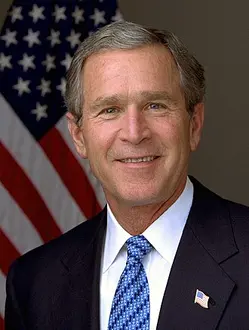
US president (2001-2009); governor of Texas (1995-2000)
Bush was a conservative Republican who combined tax cuts, school accountability, faith-based initiatives and opposition to abortion and same-sex marriage with large new federal programs such as Medicare Part D and AIDS relief. In foreign policy he led the war on terror, the invasion of Iraq and a stated policy of spreading democracy, and he favored free trade and a comprehensive immigration bill with enforcement, guest workers and a conditional path to citizenship. After leaving office he warned against nativism, protectionism and isolationism.
Closest ideologies
Based on the 58 statements where George W. Bush has a known position.
- Thatcherism (91% match)
- Fujimorism (87% match)
- Make America Great Again (87% match)
- Post-fascism (87% match)
- Americanism (86% match)
Similar people
- Dick Cheney (91% alike)
- Margaret Thatcher (91% alike)
- Mitt Romney (90% alike)
- George H. W. Bush (89% alike)
- Sarah Palin (89% alike)
Known positions
- Strongly: Spreading our political system abroad should be a special calling of our nation.
- Strongly: The state should not guarantee health care to everyone.
- Strongly: Western political institutions are suitable for every civilization.
- Strongly: A country should be ready to use military force abroad on its own judgment, even if the UN Security Council has not authorized it.
- Strongly: My country may join a military alliance led by one of the great powers.
- Strongly: Failing companies should not always be left to fail.
- Strongly: My country's military strength should exceed that of its rivals.
- Strongly: It is acceptable for the government to monitor people when that helps prevent terrorism.
- Strongly: Tax rates should not rise steeply with income.
- Strongly: Government should support building nuclear power plants.
- Strongly: Allies are bound to defend one another against armed attack.
- Strongly: The worst crimes can be punished by death.
- Strongly: Abortion should be illegal in most cases.
- Strongly: Foreign powers sometimes have a right to intervene in a country's internal affairs.
- Strongly: Military intervention abroad is sometimes necessary to protect human rights.
- Strongly: Armed forces may sometimes be used for purposes beyond defending the country against attack.
- Strongly: Democracy is best even when voters make poor choices.
- Strongly: A country may join permanent military alliances.
- Strongly: The law may forbid medical help for terminally ill adults who want to end their lives.
- Strongly: The state should make immigrants learn the language of the country they settle in.
- Strongly: A healthy society depends on the traditional family, such as a married mother and father raising their children.
- Strongly: The law should not extend marriage to same-sex couples.
- Strongly: A nation does not need one main ethnic group: it can be made up of people of many ancestries.
- Strongly: No one is better suited by nature to govern than anyone else.
- Strongly: Rulers have a right to rule only because the people they rule have agreed to it.
- Strongly: Economic growth should not be limited for the sake of the environment.
- Strongly: The government should let its political opponents organise, speak and compete for power.
- Strongly: The law should treat everyone as an equal, whatever their birth, sex, race or status.
- Strongly: Islam is compatible with Western values.
- Strongly: No party's ideology should give it an exclusive right to lead the state.
- Strongly: Countries may keep controls on who enters and settles, even in the long run.
- Strongly: Women should be able to vote and stand for office on the same terms as men.
- Strongly: Society needs government of some kind.
- Strongly: Countries should keep their armed forces.
- Strongly: Public spaces such as schools and facilities should not be separated by race under the law.
- Leans: Public school science classes should present creationist accounts of origins alongside evolutionary explanations.
- Leans: Retirement benefits should come from each worker's own privately managed savings account in place of a state scheme using current contributions to pay current retirees.
- Leans: Public education money should follow the child to whichever school the family picks.
- Leans: Prices and competition generally decide better than officials what gets made and who gets it.
- Leans: Eligibility for citizenship should require immigrants to have lived in the country for ten years or longer.
- Leans: Fewer tariffs and trade barriers make all countries better off over time.
- Leans: Newcomers should adopt the host nation's culture in place of their original culture.
- Leans: Climate change does not require drastic government action.
- Leans: Jews, as a people, are entitled to a country of their own in the Land of Israel.
- Leans: The country may allow more immigration than strict limits would permit.
- Leans: Governments may spend well beyond their tax revenue to support a weak economy.
- Leans: The political goal should be victory over communism ahead of accommodation with it.
- Leans: New oil and gas wells and coal mines should be permitted.
- Leans: Distance and nationality do not weaken the duty of the rich to help the poor abroad.
- Leans: Admissions, hiring and contracts should not favor anyone on the basis of race.
- Leans: Property should belong to many people in small holdings.
- Leans: Tariffs should not be used to protect domestic industry from foreign competition.
- Leans: Religious values and institutions should shape laws, schools and public life.
- Leans: Some institutional ties between government and religion are acceptable.
- Leans: People able to work should get welfare benefits only in return for some work, such as a job or a work scheme.
- Leans: Some things are right or wrong for everyone, in every culture and era.
- Leans: International criminal trials should not be required for every political leader responsible for atrocities.
- Leans: Member states should keep the final decision on whether to follow UN decisions.