Political Ideology Atlas · All people · Take the test
North America · born 1941
Bernie Sanders
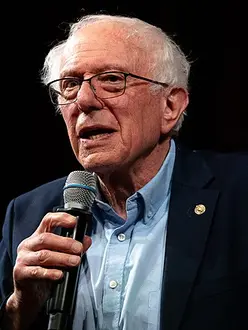
U.S. senator from Vermont (2007-present); candidate for the Democratic presidential nomination (2016, 2020)
Self-described democratic socialist who favors single-payer health care, tuition-free public college, a higher minimum wage, high taxes on wealth, strong unions and worker ownership, and large public climate investment. He opposes most trade deals, the Iraq war and mass surveillance, backs a two-state solution while pressing to cut arms sales to Israel, and rejects open borders while supporting a path to citizenship for undocumented immigrants.
Closest ideologies
Based on the 83 statements where Bernie Sanders has a known position.
- French Left (90% match)
- Green politics (88% match)
- Democratic Socialism (87% match)
- Social Democracy (87% match)
- One-state solution (87% match)
Similar people
- Alexandria Ocasio-Cortez (93% alike)
- Cory Booker (90% alike)
- Hakeem Jeffries (89% alike)
- Rob Jetten (89% alike)
- Jeremy Corbyn (89% alike)
Known positions
- Strongly: Government action should write off some or all of the student loan balance that graduates already owe.
- Strongly: Two people of the same sex can legally marry each other.
- Strongly: Currency trades and similar international financial deals should carry a small tax of their own.
- Strongly: The law limits how much landlords can charge where homes are scarce.
- Strongly: Land claimed as a historic homeland may be given up in exchange for peace.
- Strongly: Gay people, including gay men and lesbians, should be permitted to serve without concealing their sexual orientation.
- Strongly: Trade deals should impose legally binding requirements protecting workers.
- Strongly: Those who inherit a large fortune should hand over a big share of it in tax.
- Strongly: Women can legally choose to end most pregnancies.
- Strongly: The state should be barred from executing people convicted of the gravest crimes, such as terrorism.
- Strongly: Businesses should be legally barred from agreements with competitors to suppress competition, such as fixing prices.
- Strongly: Payment to a union should be permitted as a condition of employment in at least some circumstances.
- Strongly: Employees should have voting rights in the management of large companies.
- Strongly: Employers should not be able to use nondisclosure agreements or mandatory arbitration to keep sexual harassment complaints out of court.
- Strongly: Government should not back the building of new nuclear power plants.
- Strongly: Prisons should mainly help offenders rejoin society.
- Strongly: Government borrowing should be free of binding legal limits.
- Strongly: Governments may refuse permission for new oil, gas and coal extraction.
- Strongly: High earners and the very rich should pay tax at a much higher rate than everyone else.
- Strongly: Government surveillance is not acceptable, even to prevent terrorism.
- Strongly: Full-time work at the legal wage floor should pay enough to meet basic living costs.
- Strongly: Foreign powers sometimes have a right to intervene in a country's internal affairs.
- Strongly: Defeating communism should not take priority over coexistence with it.
- Strongly: Serious repeat offenders should not necessarily face mandatory minimum sentences.
- Strongly: Society should take active steps to make up for the harm done by past racial injustices.
- Strongly: A country may join permanent military alliances.
- Strongly: Non-citizens should also be eligible for welfare benefits.
- Strongly: Students should pay no tuition to attend public higher education institutions.
- Strongly: Climate change calls for drastic action by governments.
- Strongly: Workers' pay should be settled in collective bargaining between their union and their employer.
- Strongly: Universal social programmes should be kept, not replaced by programmes limited to the poorest.
- Strongly: Government should impose strict rules on how corporations operate.
- Strongly: Free trade does not benefit everyone in the long run.
- Strongly: The law should impose no restrictions on strikes.
- Strongly: Workers are better off for having labor unions.
- Strongly: Being free requires having the practical resources to act on one's choices, such as an adequate livelihood.
- Strongly: Animals can suffer, and that suffering counts in how we treat them.
- Strongly: The state should guarantee health care to everyone, whether it runs the services itself or pays for them.
- Strongly: Racism is still the main obstacle to the advancement of disadvantaged racial groups.
- Strongly: Income-tax percentages may differ between income levels.
- Strongly: Very large concentrations of wealth threaten a free society.
- Strongly: Whatever their circumstances, everyone should be able to count on the state for enough to live decently, through benefits, pensions or public services.
- Strongly: Businesses gain too much influence over government policy from their lobbying.
- Strongly: Governments should give no subsidies, licences or protections that favour firms close to them.
- Strongly: Countries may keep controls on who enters and settles, even in the long run.
- Strongly: We have a duty to leave the planet in good condition for those who come after us.
- Strongly: The law should not punish consenting adults for same-sex relations.
- Strongly: Private owners' choice of whom they deal with should be subject to some restrictions.
- Strongly: Police forces should continue to exist.
- Strongly: Society needs government of some kind.
- Strongly: Countries should keep their armed forces.
- Strongly: Government should have other tasks besides protecting people from physical violence.
- Strongly: Collecting taxes does not in itself amount to stealing people's money.
- Leans: Population growth should be deliberately held down.
- Leans: Strict legal limits should apply to owning a gun.
- Leans: Jews, as a people, are entitled to a country of their own in the Land of Israel.
- Leans: The country may allow more immigration than strict limits would permit.
- Leans: Private businesses and markets should run most of the economy, while the government supports people who cannot meet their basic needs.
- Leans: Governments may spend well beyond their tax revenue to support a weak economy.
- Leans: Governments should answer in law for past abuses by their security forces, including unlawful killings.
- Leans: Working together internationally should count at least as much as my country's own priorities.
- Leans: Distance and nationality do not weaken the duty of the rich to help the poor abroad.
- Leans: Entertainment produced for mass audiences tends to weaken people's willingness to challenge the established social order.
- Leans: Businesses should belong to the people who work in them, for example as cooperatives.
- Leans: Countries should maintain only the weapons needed for national safety.
- Leans: Allies are bound to defend one another against armed attack.
- Leans: Making polluters pay a tax protects the environment more than setting rules for them does.
- Leans: Political power should be split among separate branches and levels that can each limit the others.
- Leans: Industries such as energy, rail and utilities should be owned by the state or public bodies, not private companies.
- Leans: Firms and banks bear the cost of their own failures, with no rescue from taxpayers.
- Leans: Military intervention abroad is sometimes necessary to protect human rights.
- Leans: It is morally acceptable to kill animals for food while minimising their suffering.
- Leans: The government should steer investment into industries it sees as key to the country's future.
- Leans: Basic local services, such as water, hospitals and local transport, should be publicly owned and run.
- Leans: People should have a direct role in making decisions where they work, live and study, rather than having those decisions made entirely for them.
- Leans: A country should reject spending cuts demanded in return for loans and set its own course.
- Leans: The nation's cause and the cause of its ordinary working people are one and the same.
- Leans: Most people in political office look after themselves first and the public second.
- Leans: A people with a shared national identity is entitled to its own self-governing state.
- Leans: Elected governments need not leave monetary policy to central banks acting on their own.