Political Ideology Atlas · All ideologies · Take the test
Sarmatism
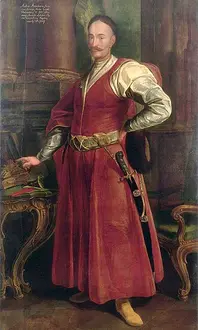
Sarmatism was the Baroque ideology of the Polish-Lithuanian nobility, who claimed descent from the ancient Sarmatians and saw themselves as an equal, free and martial ruling estate. It prized Golden Liberty (an elected, contract-bound king, a powerful Sejm, the liberum veto and a right of resistance), Catholic piety and ancestral custom, and it distrusted absolutism and foreign influence. It looked down on trade and held peasants as a lower, bound order.
What it stands for
- People farming an estate should lack the legal freedom to leave that estate.
- Even a single dissenter should be free from a decision they have refused.
- A person's sex should affect the public roles legally assigned to them.
- Some people are better suited by nature to govern.
- Special ranks held by birth, such as noble titles and hereditary crowns, may continue to exist.
- The best government combines a governing role for a few with a governing role for the wider population.
Key figures
- Jan Chryzostom Pasek: Noble memoirist whose memoirs are a major primary source of Sarmatian outlook
- Jan Długosz: Chronicler who first used the Sarmatian term in the 15th century
Closest ideologies
- Social conservatism (89% match)
- Paleoconservatism (89% match)
- Christian right (88% match)
- Christian reconstructionism (87% match)
- White nationalism (86% match)
People closest to it
- Ken Paxton (91% alike)
- Ted Cruz (88% alike)
- Matt Gaetz (88% alike)
- Pete Hegseth (88% alike)
- Charlie Kirk (88% alike)
Key positions
- Strongly: People farming an estate should lack the legal freedom to leave that estate.
- Strongly: Even a single dissenter should be free from a decision they have refused.
- Strongly: A person's sex should affect the public roles legally assigned to them.
- Strongly: Some people are better suited by nature to govern.
- Strongly: One spouse may have more authority than the other within a marriage.
- Strongly: Special ranks held by birth, such as noble titles and hereditary crowns, may continue to exist.
- Strongly: The best government combines a governing role for a few with a governing role for the wider population.
- Strongly: Owners' rights to their property should almost never be overridden, even for public goals.
- Strongly: Innate nature shapes a person's character at least as much as their environment does.
- Strongly: The representative legislature should have the final say on legislation.
- Strongly: Laws, institutions and customs today do not systematically favor men over women.
- Strongly: Inherited religious teachings may stay as handed down, without being rethought for present conditions.
- Strongly: Businesses need not belong to the people who work in them.
- Strongly: Workers should not have democratic voting rights in the management of large companies.
- Strongly: Living in the countryside does more for a person's moral wellbeing than living in a city.
- Strongly: Religious values and institutions should shape laws, schools and public life.
- Strongly: Ending a marriage should not be possible without proving fault.
- Strongly: Abortion should be illegal in most cases.
- Strongly: Large landed estates should not be compulsorily transferred to the people who farm them.
- Strongly: Political decisions should rest with the smallest local community able to handle them, with wider authorities handling matters that need a wider reach.
- Strongly: Real command of the military may rest with someone other than the head of state.
- Strongly: Ideas of what men and women are like do not come mostly from culture.
- Strongly: Workers may be represented through the parties already in place.
- Strongly: Workers' solidarity with workers in other countries should count at least as much as solidarity with their own nation.
- Strongly: Ordinary legal protections, such as the right not to be held without trial, should stay in force even in a national emergency.
- Strongly: A country can get through deadlock among its institutions without a leader who overrides them.
- Strongly: Most of government should be funded by taxes other than a tax on the value of land.
- Strongly: A person loses freedom from being at another person's mercy, even if that power is never exercised.
- Strongly: People are entitled to resist a ruler's unconstitutional exercise of power.
- Strongly: An elected legislature must approve the government's budget before the government spends public money.
- Strongly: Some cultures are superior to others.
- Strongly: Recruitment to the civil service should not depend on competitive examinations.
- Strongly: Owning a gun should not face strict legal limits.
- Strongly: Today's nation is the same people as its ancient and medieval forebears.
- Strongly: An electorate should choose the head of state, either directly or through elected representatives.
- Strongly: In the society we should aim for, a person's share of goods may depend on things besides their needs.
- Strongly: Religious institutions should be independent of government direction in their internal affairs.
- Strongly: Capitalism does not inevitably cause wars between great powers.
- Strongly: Where they conflict, religious faith should count for at least as much as evidence and reasoning.
- Strongly: The people who own the economy and hold power are not the ones the state mainly serves.
- Strongly: A healthy society depends on the traditional family, such as a married mother and father raising their children.
- Strongly: Rules need not set equal numbers of women and men on public bodies.
- Strongly: A country may keep all its decisions in its own hands rather than pooling them with other nations.
- Strongly: It is legitimate to take pride in the racial group one belongs to.
- Strongly: Rulers must act under lasting, publicly known laws administered by recognised courts.
- Strongly: Wages need not be set through negotiating bodies that the state officially recognizes.
- Strongly: Publicly honouring a national leader as the personification of the nation is not acceptable.
- Strongly: Society need not promote ways of living that differ from custom.
- Strongly: Historical change does not come mainly from changes in how society produces and exchanges goods.
- Strongly: Lasting socialism in one country does not require socialist revolutions abroad.
- Strongly: A person's right to hold land need not end when they stop using it.
- Strongly: Equality of outcomes should not be society's goal.
- Strongly: Other forces move history at least as much as conflict between classes does.
- Strongly: An economy directed by a central plan is not capable of working better than one directed by market exchange.
- Strongly: Class struggle does not continue under socialism.
- Strongly: Political violence is sometimes justified.
- Strongly: The government should let its political opponents organise, speak and compete for power.
- Strongly: Rapid economic development does not justify temporary restrictions on political freedom.
- Strongly: A socialist state with hostile neighbours need not build up its state power.
- Strongly: School history should mostly tell the story of the student's own nation.
- Strongly: Individual farms should not give way to joint cultivation by groups of farmers.
- Strongly: Someone who actually governs a state should not hand that power on to their own child.
- Strongly: Workers do not need a disciplined revolutionary party to lead them.
- Strongly: Religion does not offer illusory comfort for material suffering.
- Strongly: News media should decide for themselves what they publish, whoever holds power.
- Strongly: Political power may rest on something other than workplace-elected councils.
- Strongly: No party's ideology should give it an exclusive right to lead the state.
- Strongly: Keeping a nation's inherited culture alive, including its language, customs and traditions, matters.
- Strongly: In a war between great powers, workers need not seek their own government's defeat.
- Strongly: The armed forces may be controlled by someone other than the governing party's leadership.
- Strongly: Work may stay divided into separate specialized jobs held by different people.
- Strongly: In the long run people should still produce and share using money.
- Strongly: Some areas of life should remain outside state direction.
- Strongly: Marriage should retain legal recognition.
- Strongly: A workers' state does not need to suppress the old ruling class, even for a time.
- Strongly: Public offices may be filled by methods other than drawing lots.
- Strongly: Countries should keep their armed forces.
- Strongly: The slaughter of cattle should be legal.
- Strongly: The ruler should be subject to the country's laws.
- Strongly: The state should not be managed the way a well-run business is.
- Strongly: Killing another person can be right in self-defence or in defence of others.
- Strongly: The holder of the highest state office need not be treated as holy.
- Strongly: Taking part in politics is at least as good a way to live as living privately away from public affairs.
- Strongly: State schools need not steer pupils away from belief in God.
- Strongly: Final authority over a state's laws need not belong to its most senior religious scholars.
- Strongly: Museums, libraries and other inherited culture should not be destroyed, even when they stand in the way of new creation.
- Leans: Abandoning the faith is a crime that the state may punish.
- Leans: A government should exist, with protection against physical violence as its only task.
- Leans: Private owners should be free to refuse association, employment or service on any grounds, including discriminatory ones.
- Leans: The law limits or polices changing religion, for example to prevent pressure or inducement.
- Leans: Belonging to the nation goes with sharing its religion.
- Leans: The law may treat people differently according to such things as birth, sex, race and status.
- Leans: Income may reward the mere ownership of property.
- Leans: War develops virtues in a nation, such as courage and discipline.
- Leans: Private property does not need to serve the common good to be justified.
- Leans: Recovering how society used to be matters more than moving forward.
- Leans: Public policy need not put the needs of the poor ahead of other concerns.
- Leans: Political independence means a great deal even without economic transformation.
- Leans: People should gain political representation through social bodies such as families, local communities and occupational associations instead of political parties.
- Leans: Freedom does not require the material means to exercise it.
- Leans: Labor unions do not necessarily make workers better off.
- Leans: Voters themselves should elect the head of state, without an intermediary body selecting the officeholder.
- Leans: Eligibility for citizenship should require immigrants to have lived in the country for ten years or longer.
- Leans: Defense should rest with armed ordinary citizens, not a standing force.
- Leans: Believers can be excused from rules, such as dress or work-day rules, that conflict with their faith.
- Leans: Rules on how corporations operate may be light.
- Leans: Changes to society should be introduced a little at a time.
- Leans: After members debate and adopt a party decision, those who opposed it should not have to help implement it.
- Leans: Society may deal with racial discrimination as it arises today without programs aimed at past wrongs.
- Leans: Individual rights matter at least as much as what citizens owe their community.
- Leans: The nation's figurehead should be non-partisan and belong to everyone.
- Leans: Marriage, inheritance and family law may differ between religious communities.
- Leans: Parties that seek to abolish a country's constitutional order should be free to organize.
- Leans: People may want more than the fewest material things possible.
- Leans: Industries such as energy, rail and utilities do not need to be publicly owned.
- Leans: Only children of citizens should be citizens at birth: being born in the country should not be enough.
- Leans: The legal minimum wage need not be enough for a full-time worker to live on.
- Leans: The nation does not need a radical rebirth to overcome decadence.
- Leans: Tax rates should not rise steeply with income.
- Leans: Land stays in the hands of citizens; foreigners may not buy it.
- Leans: Besides its directly elected parliament, a legislature should have a second chamber, such as a senate.
- Leans: Government should be bound by written guarantees of basic rights protected against easy amendment by ordinary majorities.
- Leans: Rich people have an obligation to help those worse off than they are.
- Leans: Property should belong to many people in small holdings.
- Leans: Political power should be split among separate branches and levels that can each limit the others.
- Leans: Elected officials may receive a salary above what an average worker earns.
- Leans: Governments may wait for stronger scientific evidence of harm before acting on an environmental risk.
- Leans: A state founded by settlers who displaced the existing population need not be counted as a colonial project.
- Leans: State schools may teach pupils a religious faith, for example through lessons in its beliefs and practice.
- Leans: The state need not guarantee work to everyone who wants a job.
- Leans: Sharing a language is not sufficient for people to constitute one nation.
- Leans: The worst crimes can be punished by death.
- Leans: Some institutional ties between government and religion are acceptable.
- Leans: Foreign powers sometimes have a right to intervene in a country's internal affairs.
- Leans: Technology will not solve most of humanity's problems.
- Leans: A president should be limited in how many times he or she may stand for re-election.
- Leans: Government should serve people's good while respecting each person as more than an instrument of the state or community.
- Leans: Belonging to the nation ties a person's life to a sacred community that goes on after their death.
- Leans: Heirs to large fortunes may keep most of what they inherit.
- Leans: Whether a policy fits an ideology should count independently of its results.
- Leans: The country should impose strict limits on immigration.
- Leans: Some knowledge is neutral.
- Leans: Society may hold back technological change that would overturn established institutions.
- Leans: Courts need not be handed over to private businesses.
- Leans: Public spaces such as schools and facilities should not be separated by race under the law.
- Leans: Seats may be allocated in ways that do not follow parties' shares of the vote closely.
- Leans: Failure to govern under religious law does not justify armed overthrow of a ruler.
- Leans: A nation need not wait for a cultural revival before building its state.
- Leans: Voters should be able to remove elected officials before their terms end.
- Leans: Hate speech should be legal.
- Leans: Political authority need not rest on oaths of loyalty sworn to a lord.
- Leans: Society needs government of some kind.
- Leans: The general public should have at least as much say in policy as experts.
- Leans: Schools should cultivate patriotic feeling: loyalty to and pride in the nation, expressed for example through respect for its flag and anthem.
- Leans: A nation does not need one main ethnic group: it can be made up of people of many ancestries.
- Leans: The vote keeps a government in check at least as well as being able to leave the country does.
- Leans: No state may force a minority out of the country, however hostile it judges that minority to be.
- Leans: People of different races should not be discouraged from forming a family together, including through marriage and children.
- Leans: The state may restrict what adults do for reasons other than preventing harm to others.
- Leans: Being the law gives a rule a moral claim to be obeyed.
- Leans: Rulers have a right to rule only because the people they rule have agreed to it.
- Leans: Politics should support people's spiritual well-being.
- Leans: Economic growth should not be limited for the sake of the environment.
- Leans: At least some revolutions have been justified.
- Leans: Looking after your own interests is not a moral good in itself.
- Leans: Laws should not be required to follow religious texts.
- Leans: Political authority does not ultimately come from God.
- Leans: A people's connection to its ancestral land is spiritual, beyond practical interests or ordinary affection.
- Leans: Being the first to use force can be right, depending on what it is meant to achieve.
- Leans: Groups have rights of their own.